You may feel like the judge heard your family law case, signed an order, and left you with a result that doesn't reflect what transpired. Maybe the custody order overlooks key facts. Maybe the property division feels one-sided. Maybe a protective order or support ruling turned on a legal mistake that changed everything.
That feeling matters, but an appeal isn't about asking a new court to retry your case from scratch. It's about asking an appellate court to review whether the trial court made a legal error that affected the outcome. One of the most misunderstood parts of that process is oral argument.
When clients ask what is oral argument in a texas appeal and do you need it, they usually want a direct answer. Oral argument is a short, formal discussion between appellate lawyers and judges about the legal issues already raised in the briefs. Sometimes it helps a great deal. Sometimes the better strategy is to let the briefs do the work.
Your Path to a Fair Outcome After an Unjust Ruling
A family law appeal often begins with a very specific frustration. A parent leaves a final hearing believing the court applied the wrong standard in a custody dispute. A spouse reads a divorce decree and sees a property division that seems untethered from the evidence. Someone facing a protective order believes the judge misunderstood the record and entered a ruling that now affects daily life.
Texas appellate courts exist to review that kind of problem. They don't decide who was more sympathetic. They decide whether the trial court followed the law, applied the right legal standard, and acted within the discretion Texas law allows.
That difference is important because it changes what success looks like on appeal. The goal isn't to re-argue every fact. The goal is to identify a reversible error, which means a legal mistake significant enough to justify relief from the appellate court.
Practical rule: A bad result alone isn't enough for an appeal. You need a legal error in the record, and you need a clear way to show how that error affected the judgment.
In family law cases, common appellate issues include:
- Custody rulings: claims that the court misapplied the Texas Family Code, excluded important evidence, or abused its discretion in allocating conservatorship or possession.
- Property division disputes: arguments that the court used the wrong characterization, valuation approach, or legal framework in dividing marital property.
- Support and maintenance orders: challenges to how the court handled child support, spousal maintenance, or required findings.
- Protective order cases: appellate complaints involving procedure, sufficiency of the evidence, or legal standards applied by the court.
Clients often come to this stage exhausted. That's understandable. Appeals are technical, but they also serve a simple purpose. They give you a structured way to seek correction when the trial court got the law wrong.
What Is Oral Argument in the Texas Appellate Process
A client has already lived through trial, paid for the record, and waited through briefing. Then one question lands hard: will anyone from our side get to stand up in court and answer the judges' concerns face to face?
Sometimes yes. Sometimes no. In a Texas appeal, oral argument is a short, focused presentation to the appellate court after the briefs are filed. It gives the judges a chance to question counsel about the legal issues that may control the outcome.
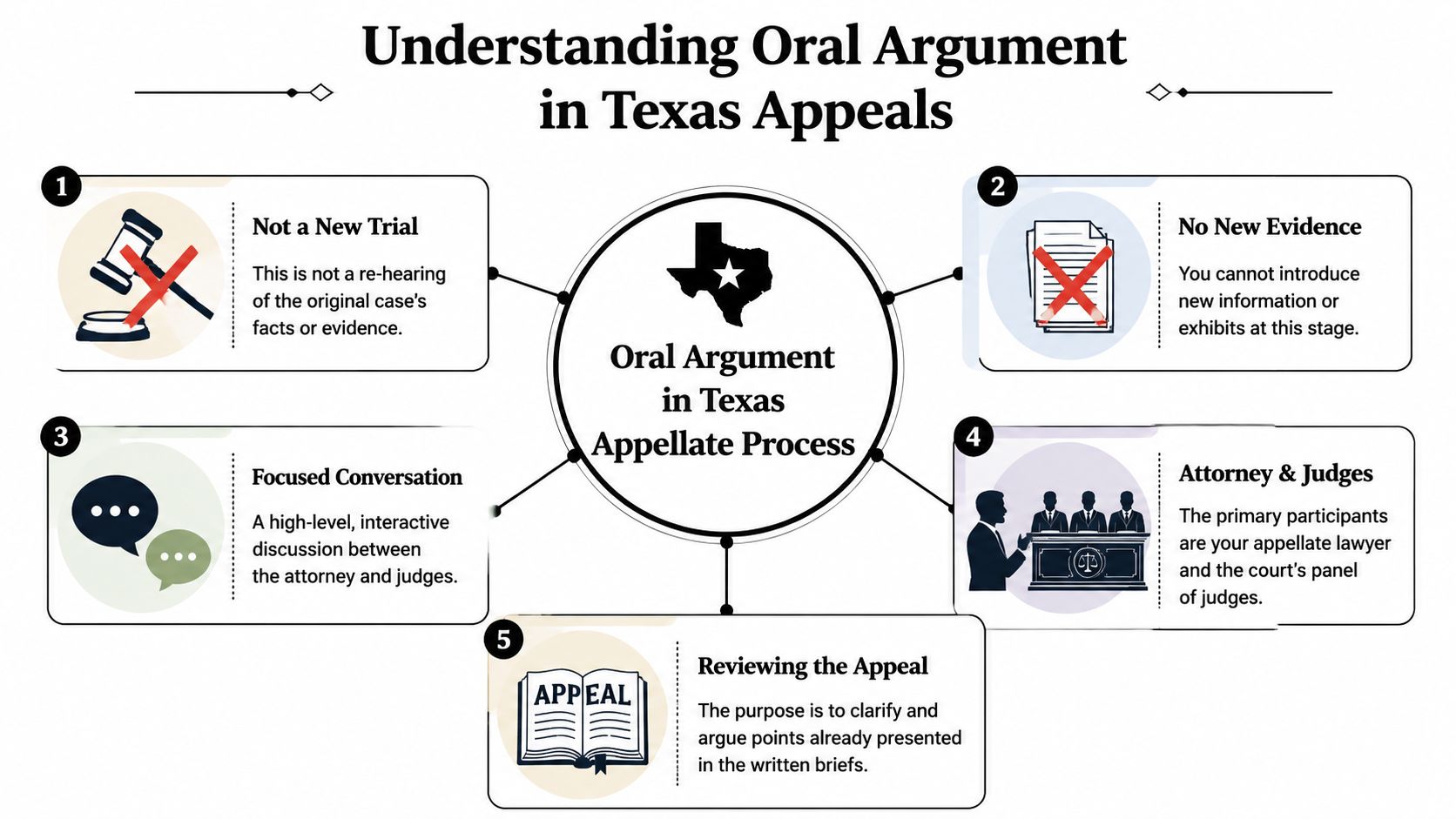
Oral argument is a structured exchange between the lawyers and the appellate judges assigned to the case. The court is not taking new evidence. No witnesses testify. No one gets a second chance to build a better factual record. The discussion stays tied to the appellate briefs and the trial court record.
In most family law appeals, that matters a great deal. Custody, property division, support, and protective-order cases often turn on standards of review, preservation problems, and whether the complained-of error probably affected the judgment. Oral argument can help if the written briefs leave room for doubt on one of those points.
How it differs from a trial
An appeal is a legal review, not a replay of trial.
At trial, lawyers build facts through testimony and exhibits. On appeal, the judges start from a closed record and ask whether the trial court followed the law, used the right legal standard, and stayed within the discretion Texas law permits. Oral argument reflects that difference. It usually feels less like a dramatic courtroom event and more like a concentrated testing session led by the panel.
Time is limited. In many Texas appellate courts, each side often gets only a short block of time, and judges may begin questioning counsel within the first minute. A lawyer who cannot answer directly, cite the record precisely, or explain the requested relief will lose ground quickly.
What judges are testing
Judges use oral argument to press on the weak points, the unclear points, and the points that may decide the case. In family law appeals, those questions often include:
- Standard of review: Is this a deferential abuse-of-discretion case, or does it present a legal question the court reviews more closely?
- Error preservation: Did trial counsel make the objection, request, or offer of proof needed to preserve the complaint?
- Record support: Where in the reporter's record or clerk's record is the fact or ruling that supports your position?
- Harm: Why did the alleged error matter enough to justify reversal?
- Remedy: If your side wins, should the court render judgment, remand for a new trial, or send back only a limited issue?
A few terms come up repeatedly:
- Abuse of discretion means the trial court acted outside the range of reasonable decisions allowed by law.
- Reversible error means the mistake likely affected the outcome, not just that the judge may have gotten something wrong.
- Appellate panel means the judges hearing the appeal, usually three justices in an intermediate court of appeals.
- Briefing means the written arguments and authorities each side files before the court decides the case.
Oral argument helps most when it answers the court's hardest question clearly and fast.
That is why oral argument is not automatically worth requesting in every appeal. If the law is settled, the record is thin, or the key problem is preservation, argument may not change much. But if a family law appeal turns on a close statutory question, a confusing procedural history, or a remedy the court may hesitate to grant without testing counsel's position, oral argument can be worth pursuing.
Texas appellate courts also grant oral argument selectively. The Texas Rules of Appellate Procedure explain that courts hear argument when it would significantly aid the decisional process. In practice, that means oral argument often signals that the panel sees a real question worth probing, not that either side is guaranteed anything.
For a fuller explanation of how the record, briefing, and standards of review fit together in these cases, see this guide to Texas appellate procedure in family law.
How to Request or Waive Oral Argument in Texas
In Texas, oral argument isn't automatic. If you want it, you have to ask for it correctly. If you don't, you may lose the chance to participate even if the court later decides to set the case for argument.
The basic procedure
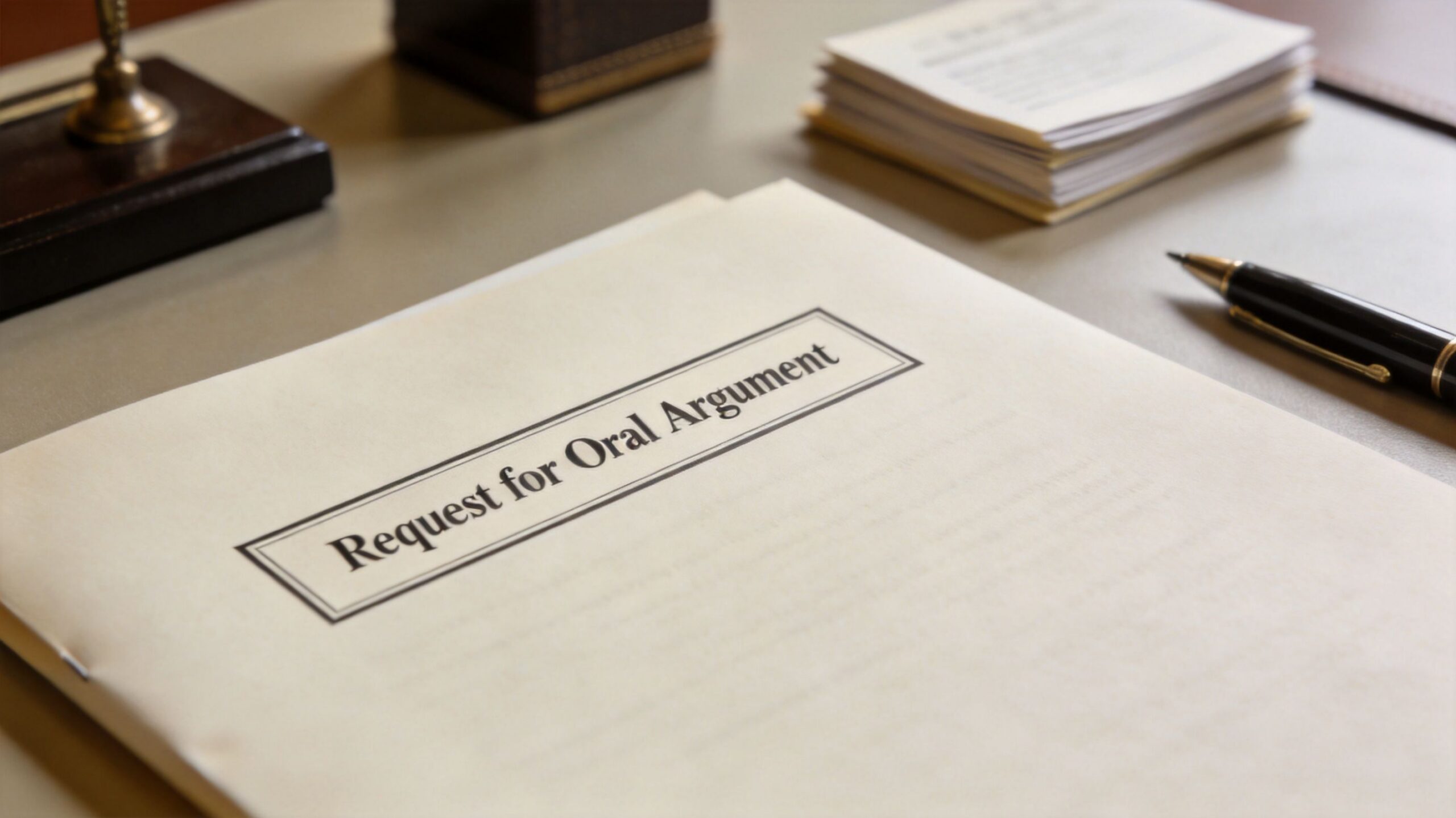
Under the Texas Rules of Appellate Procedure, the party requesting oral argument must state that request on the front cover of the brief. That step matters. If the brief doesn't include the request, the party can waive participation rights.
The usual sequence looks like this:
- File the notice of appeal and secure the record. This begins the appellate process and ensures the reviewing court has the clerk's record and reporter's record from the trial court.
- Prepare the appellant's brief. The legal issues, authorities, and requests for relief are presented in this document.
- Include the oral argument request on the brief cover. This is the formal step that preserves the request.
- Wait for full briefing to close. After the appellee files its brief, the court reviews the written submissions and decides whether argument would help.
- Receive the court's decision. The court may grant oral argument, deny it, or in some situations set the case and allow waiver.
Why courts deny some requests
The rule isn't whether a party wants oral argument. The question is whether oral argument will help the court decide the case.
According to a Texas Bar discussion of appellate practice, appellate courts may deny oral argument if the appeal is frivolous, if controlling issues have already been authoritatively decided, if the briefs and record already present the issues adequately, or if argument wouldn't significantly aid the decisional process. That same discussion notes that courts in Dallas and Houston routinely deny requests more often because of heavy caseloads, while San Antonio and Amarillo grant argument more often. You can read that analysis in the Texas Bar appellate guidance on oral argument practice.
That local variation changes strategy. In a high-volume district, the brief often has to carry more of the persuasive load. In a district that is more receptive to oral argument, a well-framed request may have a better chance.
A request for oral argument should answer one unspoken judicial question: why does this case need live discussion beyond the briefs?
For a practical overview of preserving appellate rights from the start, this resource on perfecting an appeal in Texas family court is a helpful companion.
When waiving may be deliberate
Waiving oral argument isn't always a sign of weakness. Sometimes it's a disciplined choice. If the legal error is straightforward and the briefing is strong, some lawyers prefer to avoid creating an opening for difficult questions that don't improve the court's understanding.
That choice should be made case by case. In family law appeals, the value of oral argument depends heavily on the issue, the record, and the court hearing the case.
Strategically Deciding If You Need Oral Argument
The better question isn't "Can we request oral argument?" It's "Will oral argument help this appeal enough to justify the risk?"
That question matters because oral argument has real upside, but it also creates exposure. Judges can focus immediately on the weakest part of your case. If the lawyer doesn't answer directly and confidently, the argument can hurt more than help.
The real trade-off
There is an old appellate saying that you can win on the brief but lose at oral argument. The saying survives because it captures a truth about appellate practice. Written briefing is controlled, careful, and heavily edited. Oral argument is live. Judges interrupt. Questions can shift quickly. Weak record citations or overstatements become visible fast.
At the same time, oral argument can be very useful in close family law cases. It gives counsel a chance to explain why a discretionary ruling crossed the line from merely unfavorable to legally unsound.
A study summarized in this discussion of requesting oral argument in Texas appeals found no statistically significant difference in win rates between cases submitted on briefs alone (52%) and those with oral argument (54%) in a review of over 500 Texas civil appeals from 2018 through 2023. That supports a more strategic view. Oral argument isn't automatically necessary, and waiving it can sometimes signal confidence in the brief.
When oral argument tends to help
Family law appeals often turn on the standard of review, which is the rule the appellate court uses to evaluate the trial court's ruling. Many custody, visitation, support, and property issues are reviewed for abuse of discretion. That standard can be hard to explain with a single quote or transcript page.
Oral argument tends to be more useful when:
- The case is close: The panel may already see merit on both sides and want help sorting through the hardest legal question.
- The record is dense: A long custody record or layered financial evidence in a property case may be easier to explain live.
- The issue is unusual: Cases involving unsettled law or a specific interaction between the Texas Family Code and procedure often benefit from dialogue.
- The relief sought needs precision: Sometimes the judges want to know exactly whether you're asking for reversal, remand, modification, or a narrower form of relief.
When briefs may be enough
In other appeals, oral argument adds little.
If the issue is a clean legal error, the record is short, and the briefs clearly identify where the trial court went wrong, live argument may not materially help. Some cases are won by disciplined writing, accurate record citations, and a narrow, credible theory of reversal.
Here is a practical comparison:
| Scenario | Consider Requesting Oral Argument | Consider Relying on Briefs |
|---|---|---|
| Child custody appeal involving competing best-interest evidence | Yes, especially if the abuse of discretion issue depends on context and sequence in the record | Less likely if the preserved legal error is narrow and obvious from the transcript |
| Property division appeal with complex valuations or tracing disputes | Yes, if the judges may need help understanding the financial picture | Possibly, if one legal rule controls and the facts are not disputed |
| Protective order appeal focused on a procedural defect | Sometimes, especially if the panel may have questions about preservation or remedy | Often, if the defect is clear and the briefing is direct |
| Child support or spousal maintenance appeal | Helpful when calculations, findings, or statutory interpretation are contested | More likely if the error is mathematical, documentary, or otherwise straightforward |
| Appeal with weak preservation or uneven record support | Usually no, unless counsel has a very clear answer to the expected questions | Often safer to rely on the strongest written presentation possible |
Strong appellate strategy isn't about asking for every available step. It's about choosing the steps that improve the court's understanding of your best issue.
The most effective decision usually comes from a realistic assessment of three things: the legal theory, the quality of the record, and the habits of the court hearing the appeal.
What to Expect During Your Oral Argument
If the court grants oral argument, most clients are relieved and anxious at the same time. That's normal. The setting is formal, but the event is narrower than many people expect.
You usually won't testify. You likely won't speak at all. This part belongs to your appellate attorney.
What the hearing looks like
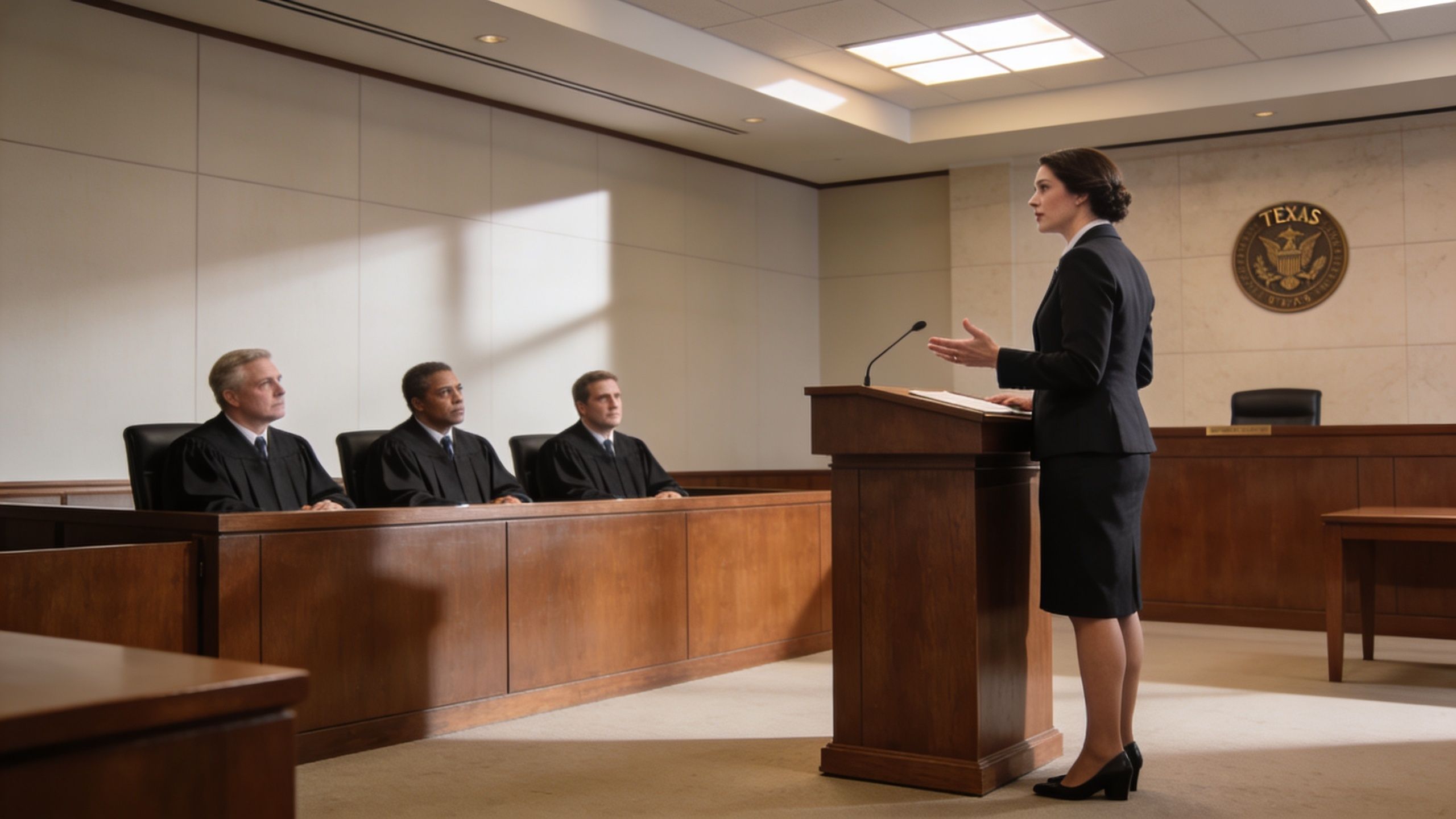
In the court of appeals, oral argument is usually held before a three-judge panel. The judges have read the briefs. They often come to the bench with specific concerns already in mind. The lawyer begins with a short introduction, but judges may interrupt within moments.
That interruption isn't a bad sign. It usually means the panel is engaged and wants to move directly to the issue it finds most important.
Most arguments focus on a small number of questions, such as:
- Where is the preserved error?
- What standard of review controls?
- How did the alleged error affect the judgment?
- What exact relief should the appellate court grant?
What makes a strong argument
A strong oral argument is focused, candid, and disciplined. It doesn't try to re-try the whole family case. It identifies the one or two issues most likely to matter and answers questions directly.
Family law appeals often involve abuse of discretion, especially in custody and property division cases. As explained in this overview of civil appeals and oral arguments, oral argument is most valuable in close cases or discretionary rulings because it lets counsel clarify written arguments and respond to judicial questions in a way a cold record can't.
Good appellate lawyers prepare for questions like these:
- "Counsel, where exactly did your client preserve this complaint?"
- "Why isn't this a disagreement with the trial judge's weighing of the evidence?"
- "If we agree with you, do we reverse the whole order or only part of it?"
Those questions matter because they test whether the appeal is legally sound, not just emotionally compelling.
For a better sense of how appellate lawyers use the record when answering these questions, this explanation of the statement of facts in a Texas family appeal helps show why precise citations are so important.
What clients should do
Your role is usually to be present, listen, and let counsel handle the exchange. Preparation still matters on your end, but it is different from trial preparation.
A helpful client usually does three things:
- Reviews the main issues: Know which rulings are being challenged and what relief is being sought.
- Trusts the narrowing process: The argument may focus on fewer issues than the brief. That's often a strength, not a concession.
- Understands the timing: The court may not rule from the bench. Most appellate decisions come later, in writing.
The best oral arguments often sound less like speeches and more like careful answers to hard questions.
Partner with an Appellate Attorney to Secure Justice
A parent can leave trial court feeling certain the ruling was wrong and still have no clear answer about the next move. An appeal is not a second trial. It is a disciplined review of what the judge decided, what objections were preserved, and whether the error is one the court of appeals can correct.
That is why appellate counsel matters in family cases. Custody, support, property division, and protective orders often involve mixed standards of review, incomplete records, and rulings that look unfair but are hard to reverse unless the issue is framed precisely. A seasoned appellate lawyer does more than write a brief. Counsel evaluates whether oral argument will help in your court, on your issues, and with your record.
That judgment should be based on current court practice, not hunches or recycled advice. The Texas Courts of Appeals Annual Statistical Report tracks how often cases are submitted with oral argument versus on briefs across the courts of appeals. Those court-specific patterns matter. In some appeals, a request for argument is worth pressing because the panel may have practical questions about preservation, harm, or the scope of a remand. In others, the better course is to devote resources to sharpening the briefing and record citations.
Clients usually want a simple answer. Should we ask for oral argument or not? The honest answer is that it depends on the case posture and the likely benefit. If oral argument gives the court a cleaner path to rule in your favor, ask for it and prepare hard for it. If the briefs already present the issue cleanly and argument is unlikely to change the result, waiving it can be the sounder strategic choice.
If you believe the court made a serious mistake in your family law case, the appellate attorneys at The Law Office of Bryan Fagan, PLLC can help you seek a fair outcome. We handle appeals involving child custody, divorce, property division, support, and protective orders across Texas. Contact our team today for a free consultation to evaluate the record, identify possible reversible error, and decide whether briefing alone or oral argument is the stronger path forward.