If a Texas court has ordered that your co-parent be named the sole managing conservator, you may feel that the case was decided unfairly. This decision can strip you of your authority to make critical decisions for your child, giving that power exclusively to the other parent. It’s a significant departure from the joint arrangement Texas courts prefer, and it is natural to feel that the system has failed you. You should know, however, that the appeals process exists to correct legal errors and seek a just outcome.
What You Can Appeal in a Sole Managing Conservatorship Order
Receiving a final order that names the other parent as the sole managing conservator can leave you feeling powerless and confused about your future role in your child’s life. This type of court order dramatically shifts the balance of parental power. A sole managing conservatorship essentially appoints one parent as the final decision-maker for every major aspect of your child's upbringing. The other parent, usually named the possessory conservator, still has the right to visitation but loses their voice on the most important issues.
Understanding the Shift in Parental Rights
Under the Texas Family Code, the law presumes that a joint managing conservatorship is in the child’s best interest. This is the standard arrangement where both parents share the rights and duties of raising their children. For a judge to deviate from this standard, there must be compelling evidence presented in court showing that a joint arrangement would be harmful to the child. A sole managing conservatorship order consolidates that shared authority into one parent's hands, giving them the exclusive power to make critical decisions.
Parental Rights at a Glance Sole vs Joint Conservatorship
The table below breaks down the key differences in decision-making power between a sole managing conservator and joint managing conservators. It clearly illustrates just how much authority shifts from a shared model to a single-parent model.
| Key Parental Right | Sole Managing Conservator | Joint Managing Conservators |
|---|---|---|
| Child's Residence | Has the exclusive right to decide where the child lives. | One parent is typically given the exclusive right, often with a geographic restriction. |
| Medical Decisions | Has the exclusive right to consent to all medical, dental, and surgical treatment. | The right is typically shared, requiring agreement or assigning one parent the final say if they disagree. |
| Psychological Care | Has the exclusive right to consent to psychiatric and psychological treatment. | This right is usually shared, though one parent may be designated as the tie-breaker. |
| Educational Decisions | Has the exclusive right to make all decisions about the child's education. | The parents typically share this right and must confer with one another. |
| Legal Representation | Has the exclusive right to represent the child in legal actions and make other major legal decisions. | This right is almost always shared between the parents. |
The shift is significant. This concentration of power is exactly why Texas law sets a high bar for ordering it. If you believe the court did not have sufficient evidence to justify removing your parental rights, you may have strong grounds for an appeal. You can learn more about the factors courts weigh in our guide on how to get full custody in Texas.
An appeal is not a second trial or another opportunity to argue the facts of your case. Instead, it is a formal review of the trial record to determine if a significant legal or procedural mistake—a "reversible error"—occurred and led to an unjust result.
The legal system provides a path to challenge an unfair outcome. An experienced appellate attorney can analyze the trial court's decision, identify potential errors, and build a strategic legal argument aimed at restoring a fair and balanced co-parenting plan for your family.
The Power of a Sole Managing Conservator

When a judge names one parent the sole managing conservator, it is a significant legal event. This is not just about where the children live; it gives one parent unilateral authority to shape nearly every aspect of a child's future. The other parent, now called the possessory conservator, is relegated to a role defined primarily by visitation schedules and support payments. Understanding the scope of these exclusive powers is the first step in determining whether the court’s decision can be challenged on appeal.
Exclusive Rights That Redefine Your Role
The primary impact of a sole managing conservatorship order is the loss of your voice in your child's life. The managing conservator can act independently, often without needing your consent or input on decisions that will affect your child for years.
This exclusive authority covers almost every critical area. A sole managing conservator has the final say on where the child attends school, can approve medical procedures, consent to psychiatric treatment, and represent the child in legal matters. They also control other important rights, like managing the child's earnings, applying for a passport, or consenting to the child's marriage or military enlistment. You can learn more about these specific powers in this overview of sole managing conservatorship.
Let's review a few of the most significant rights:
- Designating the Child's Residence: The sole managing conservator decides where the child lives. While this is often limited by a geographic restriction, they can move anywhere within that zone without your approval.
- Consenting to Medical Care: This parent can single-handedly authorize everything from routine check-ups to major surgeries. If you disagree with a proposed treatment, your opinion may have no legal standing.
- Making Educational Decisions: From choosing the school district to hiring tutors, the sole managing conservator has full control over your child's education.
The central issue in a sole managing conservatorship appeal is often whether the trial court had sufficient evidence to justify stripping one parent of these fundamental rights, especially when Texas law presumes shared parenting is best.
The Possessory Conservator's Limited Position
As the possessory conservator, your role becomes primarily defined by your visitation schedule, also known as a possession order. You have the right to see your child and a duty to pay child support, but your authority to make key decisions is removed. You still have the right to be informed about your child's health, schooling, and general well-being, but there is a significant difference between being informed and having a say. This sudden shift from partner to bystander is what often feels most unjust.
If the evidence presented at trial did not support such a drastic outcome, the judge's decision could be a reversible error. This is where an appellate attorney can help. They will examine the trial record to see if the ruling was an abuse of discretion—a legal term meaning the decision was unreasonable or made without properly considering the facts and law. If so, filing an appeal of your divorce decree or custody order is the next step toward a fairer result.
Why Texas Courts Favor Joint Conservatorship
Texas law is built on the principle that children benefit when both parents are actively involved in their lives. This is a legal cornerstone known as a rebuttable presumption that a joint managing conservatorship is in the child's best interest. In practice, this means every judge in a custody case must begin with the assumption that sharing parental rights and responsibilities is the correct outcome. The system is designed to favor co-parenting.
If a judge ordered a sole managing conservatorship in your case, the appeals process exists to scrutinize whether the trial court had a legally sound reason to overcome this strong preference for joint custody. An appeal asks a critical question: was the evidence presented truly strong enough to justify such a significant departure from the standard?
The High Bar for Sole Managing Conservatorship
For a court to grant one parent all major decision-making power, the judge must find that appointing both parents would be harmful to the child. This is a very high legal standard. The parent requesting sole managing conservatorship must provide concrete proof that shared parenting would impair the child's physical or emotional well-being.
Because the standard is high, Texas courts typically only grant this in specific situations, such as a documented history of family violence, child neglect, substance abuse, or significant criminal activity. It may also be an option if one parent has been absent from the child's life or if parental conflict is so severe that they cannot co-parent effectively. You can read more about the factors that influence these decisions on controlled conservatorships.
Common Reversible Errors in Texas Family Courts
The strong legal preference for joint parenting is often where the grounds for a successful appeal are found. A reversible error is a mistake made by the trial judge that was so significant it likely caused an incorrect and unfair outcome.
When it comes to the joint conservatorship presumption, here are a few examples of common reversible errors:
- Ignoring the Presumption: The judge awarded sole managing conservatorship without explaining on the record why a joint arrangement would be harmful to the child.
- Insufficient Evidence: The evidence of family violence, substance abuse, or conflict was weak, based on hearsay, or did not meet the high standard required to remove a parent's rights.
- Improperly Shifting the Burden: The judge acted as if it was your responsibility to prove why joint custody was a good idea, rather than requiring the other parent to prove why it would be harmful.
The key question for an appeal is not whether the judge could have made a different choice. It is whether the decision to award sole managing conservatorship was legally defensible based on the evidence and Texas law's powerful presumption for joint custody.
Understanding the Standard of Review
On appeal, the goal is to argue that the trial court committed an abuse of discretion. This legal term means the judge’s decision was unreasonable, arbitrary, or made without following guiding legal rules—like the rule that joint conservatorship is the starting point. For example, if the other parent cited minor disagreements over bedtime as "extreme conflict," and the judge used that as the sole reason for a sole managing conservatorship order, that could be an abuse of discretion because the evidence did not meet the high legal standard.
If the trial court’s decision contradicted the law's clear preference for your involvement, our appellate team knows how to build the argument to have it corrected.
Identifying Grounds for a Custody Appeal
If you feel you have lost your parental rights unfairly, it is important to understand that an appeal is not a second chance to tell your side of the story. It is a highly focused legal review of the trial court record to identify significant mistakes the judge made. The goal is to pinpoint a reversible error—a legal mistake so serious that it almost certainly led to the wrong outcome. Simply disagreeing with the judge's decision is not enough. You must show that the decision was legally flawed.
Abuse of Discretion in Custody Cases
On appeal, the higher court does not re-decide the case from scratch. Instead, it reviews the original decision through a specific legal lens known as the standard of review. For custody cases, that standard is almost always "abuse of discretion."
Abuse of Discretion is a legal term that means the trial court’s decision was unreasonable, arbitrary, or made without any reference to guiding legal rules and principles. It is not about proving the judge was personally biased; it is about showing their ruling was not supported by the law or the facts.
For instance, Texas law has a strong preference for joint managing conservatorship. If a judge ignores that presumption and orders a sole managing conservatorship without solid evidence of harm to the child, that could be an abuse of discretion. The appellate court will review the record and ask, "Was there enough evidence for a reasonable judge to have made this decision?" If the answer is no, you may have grounds for an appeal.
What You Can Appeal: Common Errors in Conservatorship Rulings
Finding a critical, reversible error is the foundation of a successful custody appeal. These mistakes can be procedural (about how the trial was conducted) or substantive (about how the law was applied). A skilled appellate attorney is trained to identify these errors in the case file.
Here are a few common reversible errors that can form the basis of an appeal of a sole managing conservatorship order:
- Misapplication of the Best Interest Standard: The judge focused on one negative factor while ignoring substantial evidence showing you are a fit and loving parent, failing to properly weigh all the "best interest" factors.
- Ignoring the Joint Conservatorship Presumption: The court awarded sole managing conservatorship without clear and compelling evidence of family violence, substance abuse, or extreme conflict that would make a joint arrangement harmful to the child.
- Improper Exclusion of Evidence: The judge refused to allow crucial testimony from your child's teacher or see text messages that proved your stability and involvement—evidence that could have changed the outcome.
- Admission of Improper Evidence: The court allowed prejudicial testimony based on hearsay, speculation, or an unqualified expert's opinion that created a false, negative impression.
These are just a few issues that can form the basis of a strong appeal. You can learn more about how these errors are identified by exploring the different grounds for appeal in civil cases. The mistake must be significant enough that, had it not occurred, the outcome of your case would likely have been different. Pinpointing that error is the first and most critical step on the path to a fair result.
Navigating the Texas Family Law Appeals Process
An appeal is very different from a trial. If you believe the judge made an error in your case, it is crucial to understand that an appeal is not a second chance to present evidence. It is a highly structured review of the trial court record, and its sole purpose is to identify legal errors. The process follows a strict roadmap with firm deadlines. An appellate court reviews the "game tape" of your trial; you cannot bring in new witnesses or introduce new evidence. The entire appeal is built from the transcripts and documents from the original case.
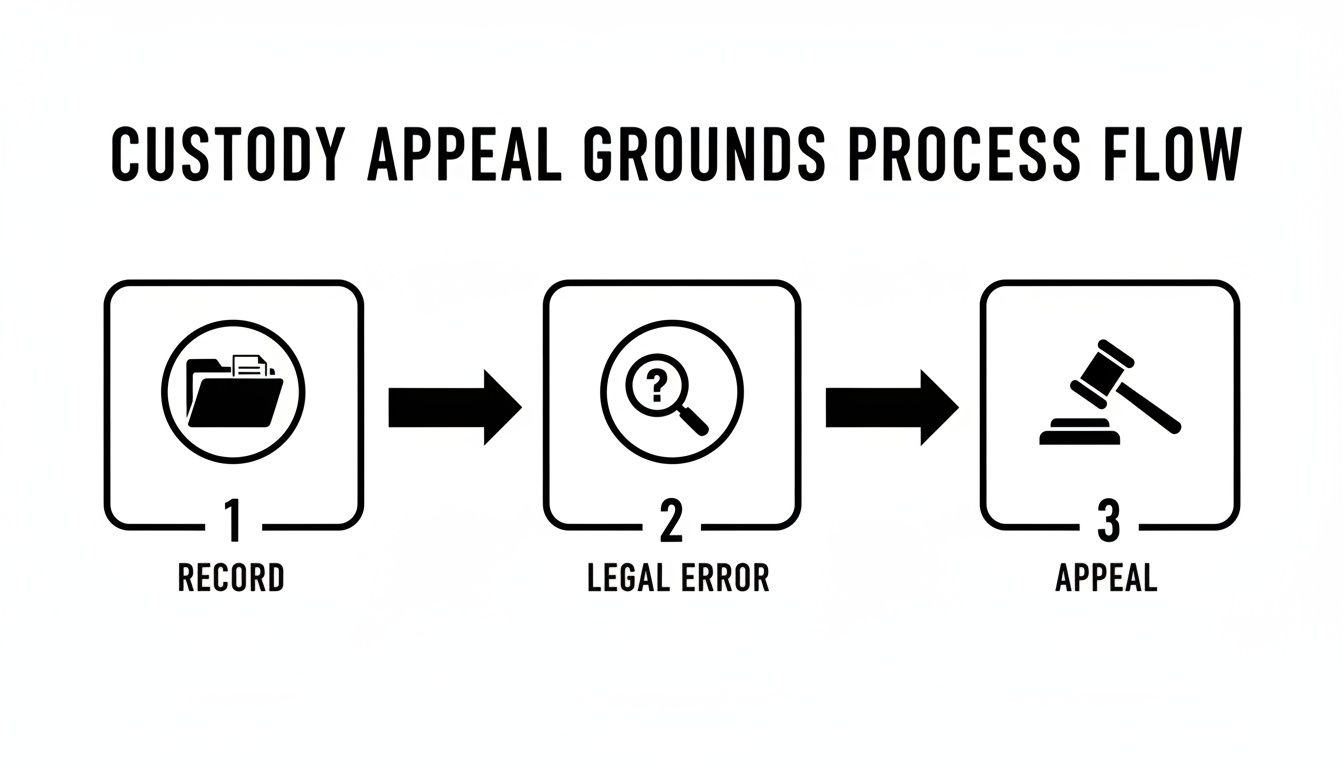
This flowchart illustrates the three core stages: the process starts with the trial record, moves to identifying a legal error, and culminates in the appeal itself. This methodical process is why the specialized skills of an appellate lawyer are so critical—they are experts at legal research, persuasive writing, and spotting the very errors that can win an appeal.
Step-by-Step Insights on How Appeals Differ From Trials
Your first step to challenge a sole managing conservatorship order is to file a Notice of Appeal. This is a straightforward document, but it is the key to initiating your appeal. The timelines are non-negotiable, typically just 30 days after the judge signs the final order. If you miss that window, your right to appeal is almost always lost.
Once the notice is filed, the work of preparing the appellate record begins. This is the official collection of everything that happened in the trial court. It consists of two parts:
- The Clerk's Record: This includes every document filed in your case, from the initial petition to the final judgment.
- The Reporter's Record: This is the official, word-for-word transcript of all hearings and trial testimony.
For the court of appeals, this record is the case. If something is not in the record, it cannot be considered on appeal.
The Role of Briefing
With the record complete, your attorney moves to the core of the appeal: briefing. The appellate brief is a formal, written legal argument presented to the higher court. This is where your lawyer meticulously connects the facts from the record to the law, identifying the specific legal mistakes the trial judge made and arguing why those errors justify reversing the decision.
An appellate brief is not an emotional plea; it is a persuasive legal document grounded in statutes, case law, and the specific facts contained within the appellate record. Its purpose is to convince the appellate judges that a reversible error occurred.
For families challenging a sole managing conservatorship ruling, the appeal will focus on whether the trial court correctly applied the "best interest of the child" standard. The brief will argue that the judge abused their discretion, particularly by ignoring the strong legal presumption in Texas that favors appointing parents as joint managing conservators. The process of submitting formal court documents correctly is governed by strict procedural rules. To better understand that first critical step, you can learn more about what a Notice of Appeal is in our guide.
Common Questions About Custody Appeals
When a judge issues an order for sole managing conservatorship, it is natural to have many questions. The idea of an appeal can seem overwhelming, but understanding the basics is the first step toward protecting your parental rights.
Let's review some of the most common questions we hear from parents considering an appeal. Our goal is to provide clarity and a realistic picture of the appellate process.
How Long Do I Have to Appeal a Custody Order in Texas?
This is the most critical question. In Texas, you have an extremely short window to act. A Notice of Appeal must be filed within 30 days of the judge signing the final order.
If you miss that deadline, you lose your right to appeal—permanently. This is why it is essential to speak with an appellate attorney as soon as you receive a ruling you believe is wrong. They need that time to review your case, identify potential errors, and file the necessary documents to protect your right to appeal.
Can I Present New Evidence During an Appeal?
This is a common misconception, but the answer is no. An appeal is not a new trial or a "do-over." You cannot bring in new witnesses, submit new text messages, or introduce any evidence that was not part of the original trial.
The appellate court acts as a reviewer of the trial record. Its only job is to look at the record from your trial—which includes the court reporter's transcript and all admitted exhibits—and decide if the trial judge made a serious legal error based on that information alone. Your appellate lawyer's entire case is built on what is already in that record.
What Is an "Abuse of Discretion" in Family Law?
This is the key legal standard required to win most custody appeals. The term "abuse of discretion" does not mean the judge was biased against you.
In legal terms, an abuse of discretion means the judge made a decision that was unreasonable, arbitrary, or disconnected from the guiding legal rules and facts presented. The ruling either had no real support in the evidence or was based on a misapplication of the law.
For example, if you provided substantial evidence showing you are a stable and involved parent, but the trial judge ignored it and awarded sole managing conservatorship based on a minor, unproven accusation, that could be an example of an abuse of discretion. Proving it, however, requires a strong legal argument that meticulously analyzes the trial record.
What Happens if My Appeal Is Successful?
Winning an appeal usually results in one of two outcomes. The first is the most common in custody cases.
- Reverse and Remand: This is the typical victory. The appellate court "reverses" (or vacates) the trial judge's incorrect custody order. It then "remands" the case, sending it back to the trial court for a new trial or hearing. This time, the trial court has clear instructions from the higher court on how to apply the law correctly.
- Reverse and Render: This is less common but can happen. Here, the appellate court not only reverses the incorrect decision but also "renders" the decision that the trial court should have made, ending the case without a new trial.
A skilled appellate lawyer can assess your case and provide guidance on the most likely outcome. The ultimate goal is to have the unjust order overturned so you have a fair opportunity to obtain a custody arrangement that is truly in your child’s best interest.
If you believe the court made a mistake in your family law case, our appellate attorneys can help you seek a fair outcome. Contact The Law Office of Bryan Fagan today for a free consultation.