You may feel your family law case was handled unfairly, especially when a court’s decision about paternity seems wrong. If you believe a judge made a mistake that led to an unjust outcome in your Dallas case, the Texas appeals process offers a path to seek a fair resolution. A wrongful paternity order can have lifelong consequences, but it doesn't have to be the final word.
This guide explains how paternity is established in Texas and how our appellate attorneys can help you challenge a court order you believe was decided in error.
Why a Paternity Judgment Can Be Appealed
It's common to feel a family law decision was unfair, especially if the fundamental question of fatherhood was based on flawed evidence or a procedural mistake. A legally recognized paternity test provides objective truth, cutting through uncertainty with hard evidence. When a Dallas County court ignores this evidence, denies a request for a test, or makes a ruling that isn't supported by the facts, it may be a reversible error—the very foundation of a successful appeal.
Without correctly established paternity, a father can't seek custody, and a child can't legally claim support or inheritance. A court order that follows a paternity test makes those rights and responsibilities official. If that order is wrong, an appeal is your tool to correct the record.
The Power of Scientific Accuracy
Modern DNA testing is incredibly precise. In Dallas and across Texas, courts rely on DNA testing that can confirm or deny paternity with a probability greater than 99.9%, leaving less than a 0.1% chance of an error. You can find more details about the specifics of paternity testing accuracy on Verner Brumley's family law blog.
This high level of accuracy is why trial courts are expected to rely on these results when making life-altering decisions. When a court fails to do so, it opens the door for an appeal based on the objective, scientific facts.
A legally sound paternity test is more than a scientific procedure; it is a tool for fairness. It ensures that child support obligations are assigned correctly and that a father’s right to be part of his child’s life is protected.
Court-Admissible vs. At-Home Kits
A critical point in many paternity appeals is the distinction between at-home DNA kits and legally admissible tests. While you can buy a kit online for personal knowledge, those results are inadmissible in a legal case.
Dallas family courts require a test where the chain of custody is strictly maintained by a neutral third party. This process guarantees:
- The samples genuinely came from the correct individuals.
- The results were not tampered with at any point.
If a trial court based its decision on an improper test or refused to order a legally admissible one, this could be a key point in your appeal.
Understanding the Paternity Process and Common Errors
When paternity is disputed in a Texas family law case, a judge will typically order a genetic test. The process begins when someone files a "Petition to Adjudicate Parentage," asking the court to legally determine the father.
After the petition is filed, a Dallas judge will hold a hearing. If there's a legitimate doubt about paternity, the judge will issue an order for a paternity test in Dallas. Ignoring this order can lead to a default judgment, where the judge declares paternity without a test. However, procedural mistakes can happen at any stage, from the initial filing to the final order.
This infographic breaks down the journey from legal uncertainty to a final resolution.
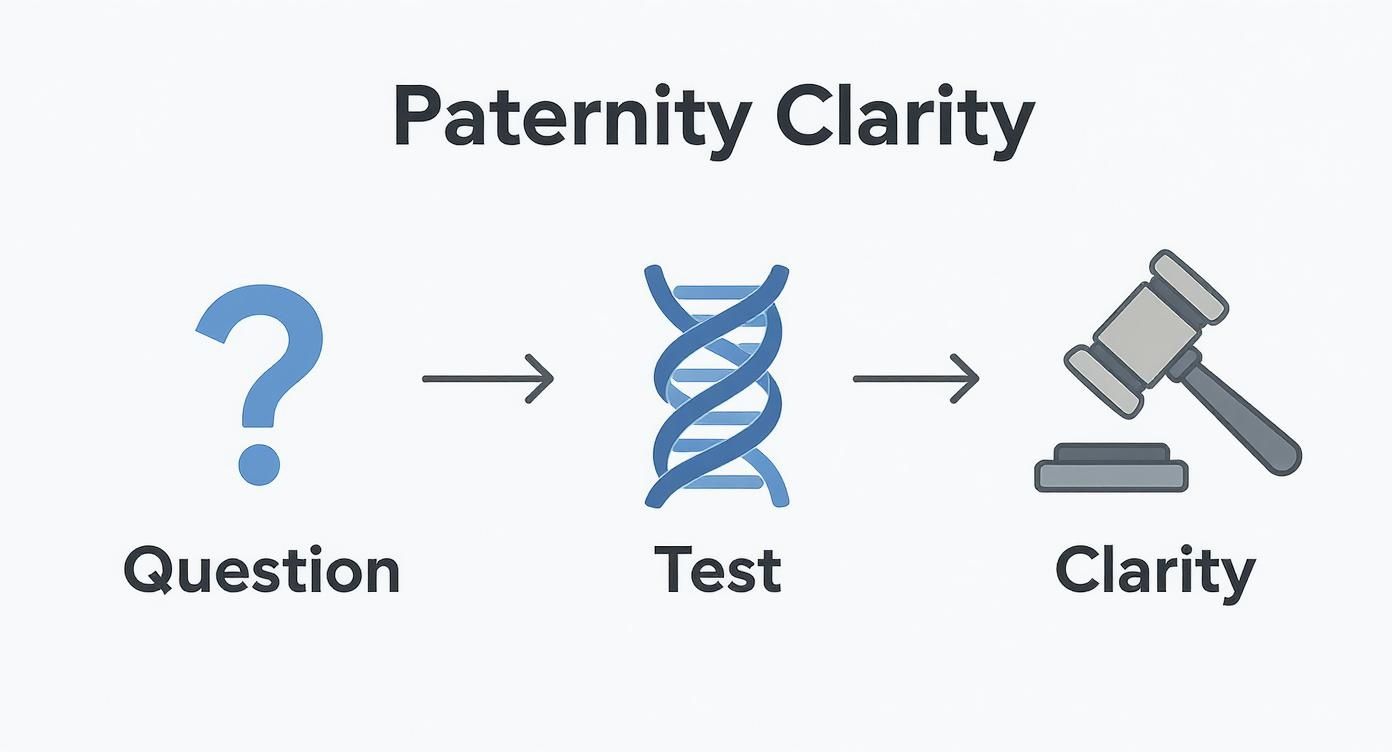
As you can see, the process flows from a legal filing to a scientific test, and finally, to a court decision. An error at any of these steps can compromise the fairness of the outcome.
Key Legal Terms You Need to Know
To understand your case, you need to know the court's language. Here are a few plain-English definitions of terms you'll encounter:
- "Presumed father": A man the law already recognizes as the father, often because he was married to the mother when the child was born.
- "Alleged father": A man who is said to be the father, but it has not been legally proven.
- “Abuse of discretion”: This doesn't mean the judge was abusive. It means the judge made a decision that was unreasonable, arbitrary, or without reference to any guiding rules or principles. For example, refusing to order a paternity test when paternity is clearly in dispute could be an abuse of discretion.
- "Reversible error": A legal mistake made by the trial court that was significant enough to have affected the outcome of the case. This is what you must prove to win an appeal.
A non-negotiable part of any court-ordered paternity test is the strict "chain of custody." This is a documented paper trail that tracks the DNA samples from collection to the final report, ensuring there's zero room for error or tampering.
Why AABB-Accredited Labs Are Critical
For a paternity test to be legally admissible in Texas, it must be performed by an AABB-accredited facility. AABB accreditation is the gold standard, guaranteeing the lab follows strict protocols for sample collection, handling, and security.
This process ensures the results are accurate and reliable. An accredited lab will use a professional collector and verify government-issued IDs. This prevents fraud and makes the results ironclad in court, paving the way for fair and final decisions on child custody, financial support, and parental rights. If the court relied on a non-accredited test, it could be a powerful basis for an appeal.
How to Choose the Right Court-Approved Testing Facility
Choosing where to get your paternity test in Dallas is a critical decision. The facility must provide results that will stand up in a Dallas County courtroom. An improper test can be deemed legally worthless, potentially harming your case.
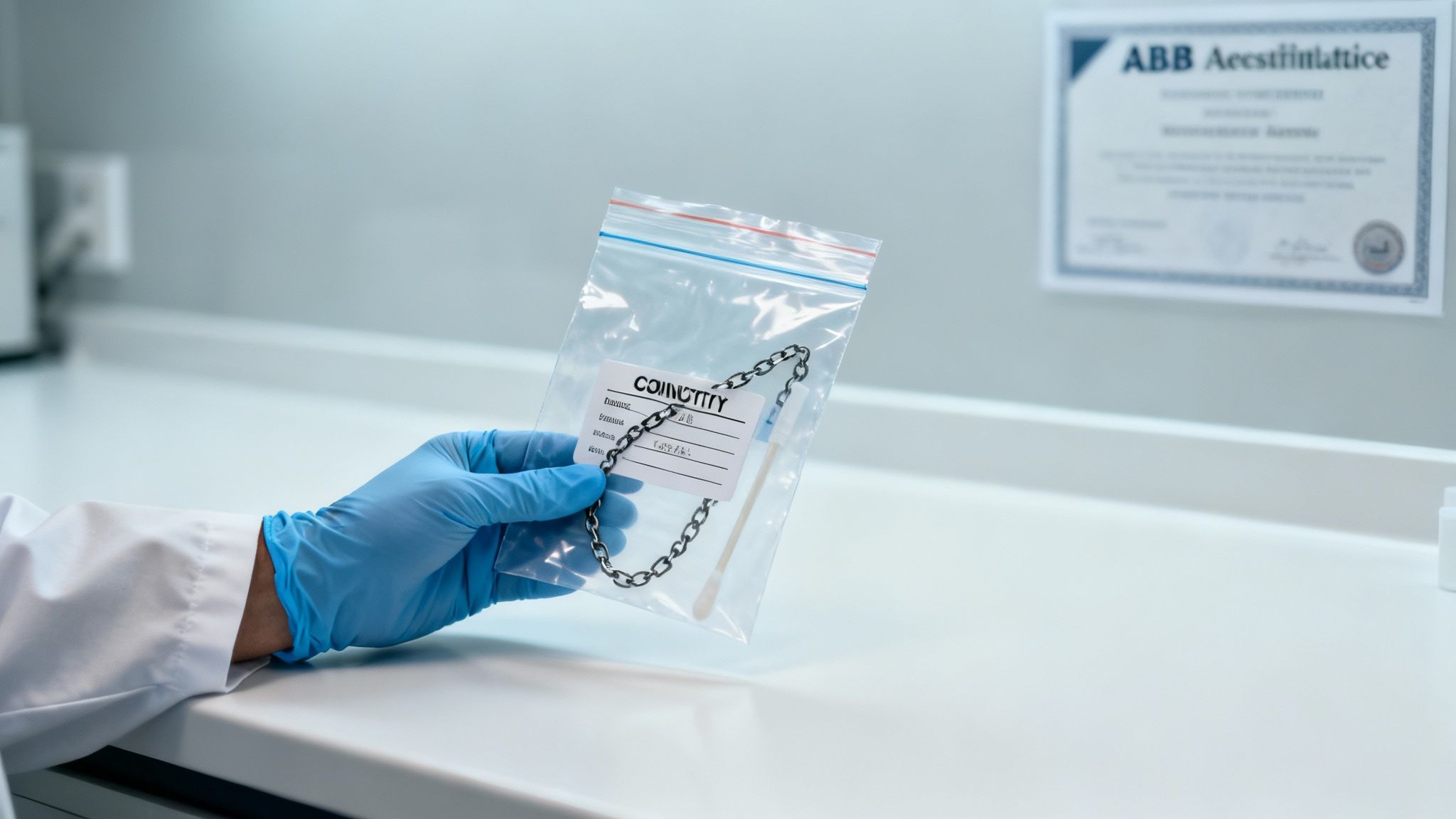
The bottom line is that the facility must be AABB accredited. This is non-negotiable for any test intended for court use, as it guarantees a proper chain of custody.
What to Look For in a Dallas Paternity Lab
When evaluating labs, focus on these critical details to ensure the results are legally sound:
- Verified AABB Accreditation: Don't just take their word for it. Verify their status on the official AABB website.
- Airtight Chain-of-Custody Process: A legitimate lab will require government-issued photo IDs, take photographs of the parties being tested, and use a neutral, trained professional for collection.
- Proper Legal Documentation: The final report must be a notarized document prepared for legal use. A simple printout is insufficient for a judge in a Texas divorce or custody case.
A word of caution: Opting for a cheap, non-accredited lab or using an at-home kit for court is a common mistake. A judge will reject those results, causing delays and additional costs. Doing it right the first time is essential.
For any legal matter, only a court-admissible test will suffice.
Comparing Paternity Test Options for Dallas Residents
| Feature | At-Home Paternity Test | Legal (Court-Admissible) Paternity Test |
|---|---|---|
| AABB Accreditation | Not required | Mandatory |
| Chain of Custody | None; self-collected samples | Strict, documented process |
| Collector | You collect the samples yourself | Neutral, third-party professional |
| ID Verification | Not required | Required (Gov't-issued photo ID) |
| Court Admissibility | No | Yes, accepted by Dallas County courts |
| Cost | Typically $80 – $200 | Typically $300 – $500 |
| Best For | Personal peace of mind, curiosity | Child support, custody, immigration, inheritance |
Understanding these differences is key to avoiding costly legal errors.
A lab experienced with the Dallas County family court system can often streamline the process. Your attorney can also recommend trusted local facilities that meet all legal standards, ensuring the evidence you present is solid and credible.
Appealing an Unfair Paternity Order
The moment you receive the results from a court-admissible paternity test in Dallas is pivotal. That document should guide the court's decisions on parental rights and financial obligations. But what happens when the court gets it wrong anyway?

If a test confirms paternity, the court will establish orders for child support and possession and access (custody and visitation). If the court's decision on support or custody feels unfair or unsupported by the evidence, you may have grounds to appeal. An unfair outcome is worth challenging, and you may wish to explore a Texas child support appeal to ensure the result is just.
If a test excludes a man as the biological father, the court should issue an order declaring he is not the legal father, terminating any future child support obligations. If the court fails to do so, or if a man was previously ordered to pay support based on a wrongful finding, an appeal may be necessary to correct the judgment.
What if a Previous Paternity Finding Was Wrong?
Texas law provides a way to challenge old paternity findings, especially if new evidence has come to light. You may have signed an Acknowledgment of Paternity (AOP) at the hospital without being sure, only to discover later that you are not the father.
A wrongful paternity finding can create years of emotional and financial hardship. The law recognizes this injustice and offers a specific legal process to correct the record when new evidence emerges.
Thanks to Texas Senate Bill 785, a man has up to one year from the moment he discovers evidence suggesting he is not the father to file a challenge. This law focuses on the discovery of new information, not just when the original paperwork was signed. If a court improperly denied your request to challenge paternity under this rule, it could be a reversible error and strong grounds for an appeal.
Understanding the Standard of Review in Paternity Appeals
https://www.youtube.com/embed/PAmx5HvAd0Q
Finding out a court has named you the legal father of a child when you believe it's not true is a difficult experience. Thankfully, the appeals process is designed to correct these kinds of injustices. An appeal is not a new trial where you present new evidence; instead, it is a strategic review of the trial record to find specific legal errors.
Perhaps you were wrongly denied a paternity test in Dallas, or the judge's decision was based on a legally invalid Acknowledgment of Paternity (AOP). These are the kinds of issues that can form the foundation of a strong appeal. Your goal is to prove the trial court made a significant mistake that directly led to the wrong outcome.
Identifying Reversible Error in Paternity Cases
To win an appeal, you must prove the court made a reversible error. This means showing the judge either misapplied the law or made a ruling that the evidence simply didn't support—what is legally known as an abuse of discretion.
An abuse of discretion occurs when a judge makes a decision that is arbitrary, unreasonable, or completely detached from established legal rules. For example, refusing to order a legally required DNA test when paternity was genuinely in question could be considered an abuse of discretion and a powerful argument for your appeal.
An appellate court's job isn't to re-try the facts. Its purpose is to ensure the law was followed correctly and fairly. When a procedural mistake or a misinterpretation of the Texas Family Code results in a wrongful paternity order, the appeals process is there to set things right.
Overturning a paternity judgment requires methodically analyzing every document and transcript from your case to pinpoint these critical errors. Your appellate attorney then builds a persuasive legal argument in a formal document called a brief, which is submitted to the higher court to argue for a reversal of the original decision.
If you feel your rights were ignored in a paternity case, a skilled family law appeal attorney can analyze the trial record for these reversible errors and help you seek the justice you deserve.
Common Questions About Dallas Paternity Tests
Facing a paternity case can bring up many practical questions. Here are straightforward answers to help you understand the process.
How Much Does a Legal Paternity Test Cost in Dallas?
A court-admissible paternity test in Dallas typically costs between $300 and $500. This fee usually covers sample collection for the child and alleged father, lab processing, and the final notarized report required by the court. At-home kits are cheaper but are not legally admissible.
Can I Refuse a Court-Ordered Paternity Test?
Refusing a court order for a DNA test is not advisable. A Dallas judge can issue a default judgment, legally declaring you the father without any DNA evidence. This action almost always harms your case and can result in you being legally responsible for child support and other parental duties.
How Long Does the Paternity Test Process Take?
The timeline can vary. After a petition is filed, it may take a few weeks to schedule a hearing. Once the judge orders the test, sample collection is arranged quickly, and lab results are often available in 3-5 business days. The entire legal process, from initial filing to a final court order, typically takes one to three months.
An Acknowledgment of Paternity (AOP) is a legal form that establishes fatherhood without a DNA test. While convenient, it carries the same legal weight as a court order. Reversing an AOP is extremely difficult, so it is critical to be absolutely certain before signing.
Establishing paternity is the legal foundation of your parental rights. You can learn more in our guide on child custody rights for fathers, which explains how legal fatherhood is the key to securing your relationship with your child.
If you believe the court made a mistake in your family law case, our appellate attorneys can help you seek a fair outcome. Contact The Law Office of Bryan Fagan today for a free consultation at https://familylawcourtappeals.com.