Skip to content
When a Texas court issues an order to terminate your parental rights, it can feel like the system has failed you and the outcome was fundamentally unfair. You may feel overwhelmed, but it is important to understand that a trial judge's decision is not automatically the end of the road. The Texas legal system provides a path to seek justice when a court makes a serious legal mistake.
Challenging an Unfair Parental Rights Termination Order
The Texas legal system has a safety net for situations where a case may have been decided unfairly: the appeals process. An appeal exists to correct judicial mistakes. If you believe the judge ignored crucial evidence, misinterpreted the law, or made a ruling that wasn't supported by the facts presented in court, these concerns often point to legitimate legal errors that can be challenged.
Trials are complex and fast-paced, and mistakes can happen.

This guide will help you understand the process of appealing a Termination of Parental Rights (TPR) case. We will explain the high legal standards, the strict deadlines you must follow, and how a skilled appellate attorney analyzes every detail of your case to find reversible errors—the legal mistakes that can lead to an unjust outcome being overturned.
Understanding the Standard of Review and Your Path Forward
First, it's important to know what an appeal is—and what it isn't. An appeal is not a new trial. You do not get a second chance to present new evidence or re-tell your story.
Instead, an appeal is a highly technical review of what already happened in the trial court. The appellate court examines the official record—transcripts of testimony, admitted evidence, and the judge's rulings—to determine if a serious legal or procedural mistake occurred. If a significant error impacted the outcome, the original decision can be reversed. Our goal is to provide a clear, calm roadmap forward and show you that there are legal options to fight for your family.
The stakes in a TPR case could not be higher; the court's order permanently severs the legal bond between you and your child. That is why the law requires such a high standard of proof. When the party seeking termination fails to meet that standard, an appeal is the most powerful tool you have to seek a fair outcome.
An appeal serves as a critical check on the trial court's power, ensuring that the fundamental rights of a parent are not terminated without proper legal and factual justification.
Successfully navigating this process requires a deep understanding of the Texas Family Code and the Texas Rules of Appellate Procedure. It is a battle fought with meticulously crafted written arguments, called briefs, that pinpoint exactly where the trial court went wrong. If you believe the court made an unjust decision, exploring an appeal is a vital step toward protecting your family's future.
The Legal Standard for Terminating Parental Rights
In Texas family law, there is no more serious or permanent action than terminating a parent's rights. Because of this severity, the law places an incredibly high burden on the party asking for the termination, which is usually the Department of Family and Protective Services (DFPS).
A judge cannot terminate your rights based on a personal opinion or because you are not a "perfect" parent. Instead, the petitioner must prove their case with clear and convincing evidence. This is a much higher standard than the "preponderance of the evidence" standard used in most civil cases. "Clear and convincing" means the evidence must be so solid that it produces a firm belief or conviction in the judge's mind that the allegations are true.
The Two-Pronged Test for Termination
Every involuntary termination of parental rights in Texas case is decided by a critical two-part legal test. The person or agency seeking termination must prove both parts. If they fail to prove either one, the termination request should be denied.
- Statutory Grounds: First, they must prove that the parent's conduct meets at least one of the specific grounds listed in the Texas Family Code § 161.001.
- Child's Best Interest: Second, they must prove that permanently severing the parent-child relationship is in the child's best interest.
When a case is appealed, the appellate court meticulously reviews the trial record to see if there was legally sufficient evidence to support the judge's findings on both of these prongs. A failure of proof on either one can be a powerful basis for a child custody appeal.
Proving a Statutory Ground
The Texas Family Code provides a specific list of reasons why a parent's rights can be terminated. It is not enough to simply claim someone is a "bad parent"; their actions must fit squarely into one of these legal categories. The petitioner must prove at least one ground with clear and convincing evidence.
To give you a clearer picture, here are some of the most common reasons cited in Texas TPR cases.
Common Grounds for Involuntary TPR in Texas
This table breaks down some of the most frequently cited reasons under Texas Family Code § 161.001 for terminating parental rights, with plain-English explanations.
| Statutory Ground | What It Means in Plain English | Common Example |
|---|---|---|
| Endangerment | Knowingly putting the child in a physically or emotionally dangerous situation. | Allowing drug use in the home, exposing the child to domestic violence, or leaving the child with a known abuser. |
| Abandonment | Leaving the child with someone else without support or any clear plan to return for them. | Dropping a child off with a relative for six months with no contact or financial support. |
| Failure to Comply with a Court Order | Not completing the required steps in a court-ordered plan designed to get your child back. | Skipping required drug tests, counseling sessions, or parenting classes that were ordered by a judge. |
| Criminal Conduct | Being convicted and imprisoned for a crime that prevents you from parenting the child. | Receiving a lengthy prison sentence that will keep you incarcerated for most of the child's minority. |
If a trial court finds that one of these grounds was met but the decision was not backed by legally sufficient evidence in the record, it constitutes a reversible error. This is exactly the kind of mistake that can be challenged and overturned on appeal.
Determining the Child's Best Interest
Even if a petitioner proves a statutory ground, the court must also find that termination is in the child's best interest. This is not a subjective judgment; it is a structured legal analysis guided by a set of factors known as the Holley Factors, which come from the Texas Supreme Court case Holley v. Adams.
These factors require the judge to consider the complete picture, including:
- The child's emotional and physical needs, both now and in the future.
- Any emotional or physical danger the child faces.
- The parenting abilities of the person seeking custody.
- The stability of the proposed home.
- The parent’s actions that suggest the parent-child relationship is not a healthy one.
This comprehensive analysis is critical. When a court terminates parental rights without properly weighing these factors, or bases its decision on insufficient evidence related to them, it can be a significant legal mistake—an abuse of discretion that an appellate court has the power to correct.
Unfortunately, Texas courts are known to move aggressively in this area. To put it in perspective, Texas has terminated parental rights for 91,589 children since 2006, a number that far outpaces any other state. This statistic highlights just how unique Texas's legal posture is in child welfare cases and underscores the absolute necessity of a robust appeals process. You can discover more about Texas's approach to parental rights termination and see why it stands apart nationally.
Understanding this high-stakes environment is the first step in identifying where a trial court may have made a critical legal error in your case.
How an Appeal Differs from a Trial
If you have been through a difficult trial and feel the outcome was unjust, it is natural to think of an appeal as a second chance to tell your story to a new judge. While that is an understandable assumption, it is not how the appellate process works. An appeal is not a new trial; it is a different process with its own rules and a distinct goal.
Think of it this way: the trial was the process of building a house, where lawyers presented materials (evidence, testimony) to the judge, who then constructed the final structure (the verdict). An appeal is like an inspection of that finished house.
The appellate court will not bring in new materials or pour a new foundation. Its job is to examine the original blueprints (the law) and the final construction (the trial court's decision) to see if a critical error was made that violates the legal "building code."
The Focus Shifts from Facts to Legal Errors
At trial, the focus is on establishing facts. In a termination of parental rights Texas case, that means proving or disproving the statutory grounds for termination and arguing about the child's best interest. Witnesses are called, documents are presented, and a factual narrative is built.
On appeal, that phase is over. You cannot introduce new evidence or have a witness re-testify. The focus shifts entirely to one critical question: Did the trial court make a serious legal mistake? In legal terms, these are called reversible errors.
A reversible error is a mistake in legal procedure or the application of law that was so significant, it likely changed the outcome of the case. Pinpointing these errors is the whole point of an appeal.
The appellate lawyer's job is to act as a legal detective, carefully reviewing the case file to find these crucial missteps.
The Record Is Everything
In an appeal, the entire case is confined to the trial record. This refers to two specific things:
- The Clerk’s Record: A collection of all official documents filed in your case, such as the initial petition, motions, judge's orders, and all exhibits admitted into evidence.
- The Reporter’s Record: The word-for-word transcript of everything said in open court, captured by the court reporter.
What happens on appeal is determined only by what is inside that record. Our appellate team meticulously dissects these documents, looking for instances where the judge misapplied the law, improperly admitted or excluded evidence, or made a decision that the facts in the record do not support. This requires a different skill set from trial work, focusing on deep legal analysis and persuasive writing rather than courtroom performance.
The infographic below shows the two-part legal standard from the trial that the appellate court reviews for error.
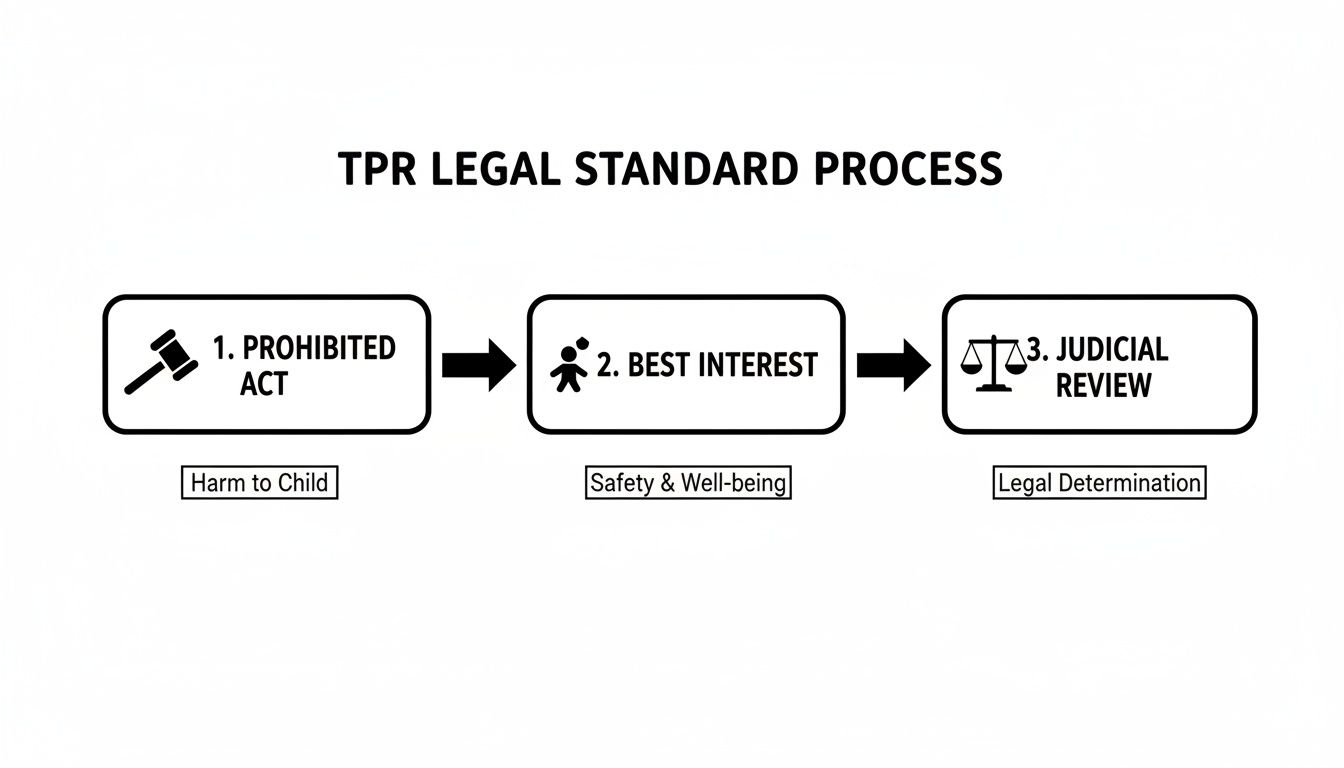
As you can see, the state had to prove both a prohibited act and that termination was in the child's best interest. An appeal investigates whether the evidence contained within the official record was legally sufficient to support both of those findings.
From Spoken Arguments to Written Briefs
A trial often hinges on powerful live testimony and oral arguments. An appeal, however, is won or lost almost entirely on paper.
The central tool of an appeal is the briefing. This refers to a series of highly structured, formal legal documents submitted to a panel of appellate judges. It is a powerful piece of legal advocacy that accomplishes three things:
- It clearly identifies the specific legal errors the trial court made.
- It uses statutes and previous appellate court decisions (case law) to prove why it was an error.
- It explains how that error was harmful and why the trial court's decision must be overturned.
This work is highly technical and analytical, demanding an encyclopedic knowledge of the Texas Family Code and the Texas Rules of Appellate Procedure. It is a battle of legal intellect, where precision, clarity, and the strength of the written argument carry the day. Often, the appellate judges make their final decision based on these briefs and the record alone.
Understanding Common Reversible Errors in Texas Family Courts
The feeling that your trial was fundamentally unfair is often tied to a specific legal mistake—an error that can be challenged and, with the right argument, overturned on appeal. An appeal is not a second chance to tell your story; it's a critical review to determine if the trial court followed the law.
Identifying these mistakes is the foundation of a successful appeal. You cannot simply tell a higher court you disagree with the outcome. You must pinpoint a precise legal or procedural error that was so damaging it likely caused the wrongful termination of your parental rights.
Insufficient Evidence to Meet the High Standard of Proof
The most common reversible error in TPR cases is a failure of proof. The party seeking to terminate your rights has a massive burden: they must prove their case with clear and convincing evidence. This is an incredibly high standard, and appellate courts scrutinize the record to ensure it was met.
We often see cases where a judge's decision was based on weak grounds—speculation, past incidents that have since been resolved, or testimony that does not hold up under scrutiny. If the evidence presented fails to create a "firm belief or conviction" that the allegations are true, the termination order cannot stand.
Improper Analysis of the Child's Best Interest
Another frequent error occurs when the trial court fails to correctly analyze what is truly in the child's best interest according to the law. A judge cannot simply state that termination is best for the child. They are required to weigh a specific set of criteria known as the Holley Factors.
These factors include:
- The child’s emotional and physical needs.
- The stability of the proposed home.
- Any parental actions or failures showing an unhealthy parent-child relationship.
- Any emotional or physical danger to the child.
When a judge ignores these factors, applies them incorrectly, or makes a finding with no evidence to back it up, it can be a reversible error. An appellate court may rule that the trial court's decision was an abuse of discretion.
An abuse of discretion is a legal term for when a trial judge makes a decision that is so arbitrary, unreasonable, or contrary to guiding legal principles that it's considered an invalid exercise of their power.
Procedural and Due Process Violations
Sometimes, the error is not about the evidence but the process itself. Your constitutional right to due process requires the government to follow strict rules before it can take away a fundamental right, like the right to raise your child.
Procedural errors can be powerful grounds for an appeal. For example, a parent might not have received proper legal notice of the termination hearing. Without that notice, they lose their opportunity to appear and defend themselves, making the entire proceeding fundamentally unfair. You can learn more about the different types of mistakes that can serve as the foundation for an appeal by reviewing the common grounds for appeal in family court.
Examples of Reversible Errors in TPR Appeals
This table highlights common legal mistakes made by trial courts in TPR cases that can be challenged and potentially overturned on appeal.
| Type of Error | How It Happens in a TPR Case | Why It Matters for an Appeal |
|---|---|---|
| Insufficient Evidence | The evidence presented does not meet the "clear and convincing" standard required to prove statutory grounds or best interest. | The appellate court can reverse the termination because the high legal burden of proof was not met. |
| No "Best Interest" Finding | The judge terminates parental rights without explicitly stating on the record that it is in the child's best interest. | This is a fatal flaw. A "best interest" finding is a non-negotiable legal requirement in every TPR case. |
| Abuse of Discretion | The trial court's decision is based on a misapplication of the law (like the Holley factors) or is unsupported by the facts. | An appellate court can determine the judge acted unreasonably or arbitrarily, and send the case back. |
| Procedural Due Process Violations | A parent was not properly served with notice of the lawsuit, not given a chance to be heard, or denied their right to an attorney. | These errors violate fundamental constitutional rights, which can invalidate the entire proceeding. |
| Improper Admission of Evidence | The trial court allowed prejudicial, irrelevant, or legally inadmissible evidence (like hearsay) to influence its decision. | If the wrongful termination was based on evidence that never should have been considered, the decision can be reversed. |
Identifying these kinds of mistakes requires a meticulous, detail-oriented review of every document, transcript, and ruling from your case. It is about ensuring the law was applied correctly and that your family was given a fair fight.
Navigating the Aggressive Timelines in Texas CPS Cases
The Texas legal system moves at an accelerated pace in child welfare cases. This is by design, as the law is structured to fast-track these cases toward a final resolution. This often leaves parents feeling a step behind from the very beginning.
Texas has a uniquely aggressive approach. It is common for CPS to file a petition to terminate parental rights on the very first day of the case. This tactic, known as pleading in the alternative, immediately puts parents on the defensive. From day one, you are forced to fight for your family while also managing a complex and often confusing court-ordered service plan. The pressure this creates is immense.
The Impact of Expedited Timelines
This rapid pace dramatically increases the risk of procedural mistakes and judicial errors. When a case is rushed, critical details can be missed, evidence may not be fully developed, and the life-altering decision to end a parent-child relationship can be made without proper consideration.
This is where an appeal acts as a crucial safety net.
It forces a necessary pause, giving a higher court the chance to meticulously review what happened and ensure a parent’s fundamental constitutional rights were not compromised for the sake of speed. This review is essential to guaranteeing fairness and due process were followed.
An appeal serves as a check on the trial court's power. It ensures that the aggressive timelines set by Texas law didn't lead to a wrongful termination based on legal error.
This is a documented reality. Federal oversight bodies have pointed out that Texas "generally moves swiftly to termination of parental rights," with many cases concluding faster than federal guidelines require. Texas law permits CPS to file for termination the moment a child is removed for alleged abuse or neglect. You can read the full report about these findings to see the data for yourself.
This statutory framework means parents must build an effective defense immediately to protect their rights.
Why Every Deadline Is Critical
If the trial court timeline feels fast, the deadlines for an appeal are even more unforgiving. Once a judge signs the final termination order, a new clock starts ticking—and it is incredibly short and strict.
- Notice of Appeal: You typically have only 20 days to file your Notice of Appeal. Missing this deadline will almost certainly result in losing your right to challenge the court's decision.
- Record Preparation: The official trial court record must be compiled and filed on an accelerated schedule.
- Briefing Deadlines: The deadlines for filing the appellate briefs—the detailed written arguments that form the heart of your appeal—are also significantly compressed.
These tight windows leave no room for error. It is vital to contact an appellate attorney as soon as you receive a ruling you believe is unjust. This ensures the first crucial steps, like filing the Notice of Appeal, are handled correctly and on time, which is the only way to preserve your chance to seek justice.
How Our Appellate Team Fights for a Fair Outcome
If you are facing the devastating outcome of having your parental rights terminated, it can feel like there is no path forward. But there is. The Texas appeals process was created for situations just like this—to correct legal errors and ensure justice is served. Our appellate attorneys are specialists, dedicating their practice to the meticulous work required to build a powerful appeal.

We conduct a deep and thorough review of every page of the trial transcript, every piece of evidence, and every motion filed in your case. Our entire focus is on identifying reversible errors—mistakes made by the trial court that are significant enough to overturn the original decision. From there, we build a persuasive legal argument to present to the higher court.
Our Strategic Approach to Your Appeal
Our process is centered on precision and a deep understanding of the law. We begin by conducting an exhaustive review of your case file, scrutinizing it for any missteps regarding evidence, procedure, or the strict application of the Texas Family Code. We understand the stakes could not be higher, which is why we handle every appeal with the calm, strategic, and confident focus your family deserves.
We become your voice for fairness and due process in the court of appeals. To manage the immense amount of information in these complex cases, our team often relies on specialized tools, including advanced legal data integration and reporting services, to ensure no critical detail is ever missed.
An appeal isn't a second trial. It's a focused argument to prove the trial court’s decision was legally incorrect. Our mission is to build the strongest possible case showing precisely why that original ruling must be reversed.
Our team has honed the specific skills needed for this unique area of law. We are appellate specialists who live and breathe the complex rules of appellate procedure. When you need to challenge a court’s final order on the termination of parental rights in Texas, having an attorney who specializes in appeals is critical.
If you believe the court made a mistake in your family law case, our appellate attorneys can help you seek a fair outcome. Contact The Law Office of Bryan Fagan today for a free consultation.
Your Top Questions About TPR Appeals, Answered
When a judge terminates your parental rights, the initial shock is often followed by urgent questions. Here are plain-English answers to some of the most common things parents ask our appellate team.
How Long Do I Have to Appeal a TPR Order in Texas?
This is the most critical question, and the answer is not long at all. The deadlines for appealing a TPR case in Texas are accelerated and unforgiving.
You have just 20 days from the date the judge signs the final termination order to file your Notice of Appeal. There are almost no exceptions. If you miss this 20-day window, you will almost certainly lose your right to challenge the decision forever. You must act quickly.
What Are My Real Chances of Winning an Appeal?
The honest answer is: it depends entirely on what happened at your trial. An appeal is not a do-over. It is a highly technical process where we scrutinize the trial record for significant legal mistakes.
Winning a TPR appeal means we have to successfully argue that the trial court made a reversible error—a mistake so serious that it affected the outcome of your case. We must review the transcripts and evidence to see if a valid legal argument exists before we can give you a realistic assessment of your chances.
Can I Bring in New Evidence or Witnesses for the Appeal?
No, this is not permitted. This is one of the most common misconceptions about the appellate process. The appeals court is limited to reviewing only what happened in the original trial.
Think of it like a sports referee reviewing a controversial play. They can only watch the instant replay of what already happened on the field; they cannot bring in a new player to change the outcome. The appellate court is confined to the existing "game film"—the trial transcripts, exhibits, and court filings.
Our job is to find the legal errors within that existing record, not to introduce new facts or evidence.
What Happens if I Actually Win the Appeal?
Winning a TPR appeal is a significant victory, but it is important to understand what it means. Typically, the appellate court will "reverse and remand" the case.
In plain English, this means the termination order is vacated, and your case is sent back down to the original trial court for a new trial or other proceedings. It does not mean your parental rights are automatically restored for good, but it provides a fresh start—a second chance to fight for your child, this time with the previous legal error corrected.
If you believe the court made a mistake in your family law case, our appellate attorneys can help you seek a fair outcome. Contact The Law Office of Bryan Fagan today for a free consultation. You can reach us through our dedicated appeals site at https://familylawcourtappeals.com.