You may feel your case was handled unfairly after months, or even years, of navigating the divorce process. Reading a final divorce decree in Texas that seems unjust can be disheartening, leaving you feeling like the court didn't understand your situation. This legally binding order is the comprehensive rulebook for your post-divorce life, spelling out final terms on everything from property and kids to financial support. If you believe a serious mistake was made, it is crucial to understand that this may not be the last word.
The Power of a Final Decree and Your Right to Appeal
When a judge signs your divorce decree, it becomes a powerful court order with real, lasting consequences for your parental rights, your property, and your financial future. This document dictates every critical aspect of your legal separation. Once filed with the court clerk, its terms are not just guidelines—they are the law.
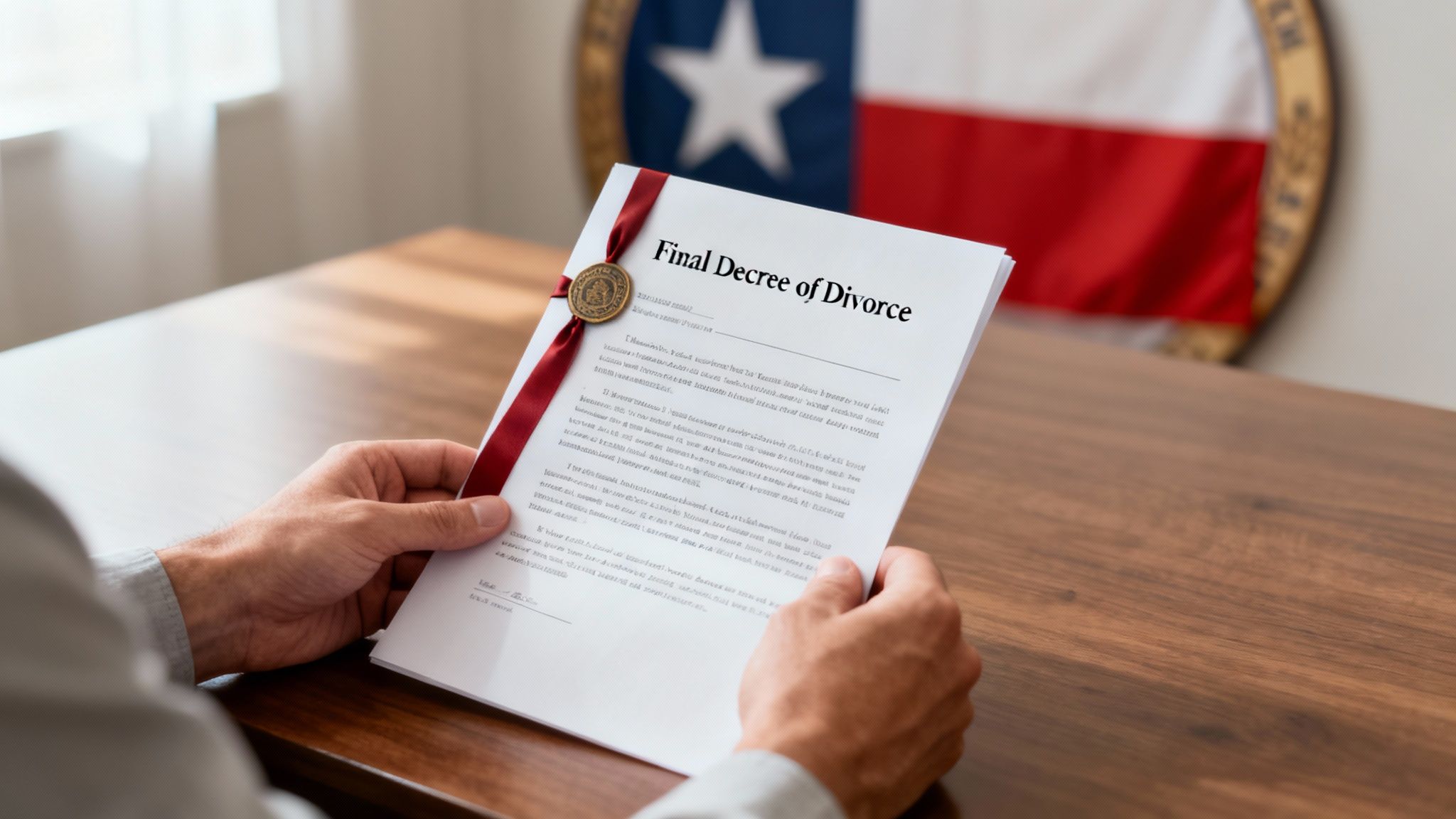
Because this order carries so much weight, it is critical that every detail is correct, fair, and legally sound. If you suspect the judge made a major error that resulted in an unjust outcome, you are not necessarily stuck. The Texas legal system provides a specific process—an appeal—designed to challenge that decision and seek a more equitable result. For more details on how the state finalizes these records, you can review information provided by the Texas Department of State Health Services.
Why Every Detail in Your Decree Matters
It is tempting to skim dense legal jargon, but the specific phrasing in your divorce decree will control your life for years. A single vague sentence or a mislabeled asset can lead to future legal battles and serious financial strain. Truly understanding the gravity of this document is the first step in identifying when a significant judicial error might have occurred.
An appeal is not a do-over or a second chance to argue your case. It is a specific legal challenge arguing that the trial court judge made a reversible error—a mistake in applying the law or evidence that likely caused an improper or unfair judgment.
The terms in your decree are not suggestions; they are commands with the full force of the law. If the judge incorrectly applied Texas property law or overlooked crucial evidence when deciding custody, the fallout is immediate and severe. This is precisely why the appellate process exists: to provide a remedy when the trial court gets it wrong. Recognizing that a mistake may have been made is the crucial first step toward correcting it.
Key Components of a Texas Divorce Decree
This table breaks down the essential sections of a Texas final divorce decree, explaining what each part controls in your post-divorce life. An error in any of these areas can be a potential ground for appeal.
| Component | What It Defines |
|---|---|
| Finding of Jurisdiction | Confirms the court has the legal authority to grant the divorce. |
| Division of Marital Property | Details the "just and right" division of all community assets and debts. |
| Confirmation of Separate Property | Identifies and awards assets owned by each spouse before the marriage or received as a gift/inheritance. |
| Child Custody (Conservatorship) | Establishes who has the right to make decisions for the children (e.g., medical, educational). |
| Possession and Access (Visitation) | Outlines the specific schedule for when each parent has the children. |
| Child Support | Sets the monthly amount one parent pays to the other for the children's care. |
| Spousal Maintenance | Orders (if granted) post-divorce financial support from one ex-spouse to the other. |
| Protective Orders | Includes any orders to prevent family violence or harassment, if applicable. |
| Attorney's Fees and Costs | Specifies which party is responsible for paying the legal fees. |
Each of these sections is a critical piece of the puzzle. An error in any one of them can have a ripple effect, impacting your finances, your relationship with your children, and your overall stability for years.
What You Can Appeal in a Texas Divorce Decree
To spot a legal mistake that might be grounds for an appeal, you first have to understand what each of these orders is supposed to do according to Texas law. Let's translate the dense legalese into what it means for you and your family day-to-day.
Property Division: How Texas Law Divides Your Assets and Debts
Texas is a community property state. This means the judge is legally required to divide your community estate in a way that is “just and right,” a standard set by the Texas Family Code. This does not automatically mean a 50/50 split.
The decree should contain meticulous lists detailing every asset and debt, assigning each one to a specific spouse.
-
Community Property: This covers nearly everything you and your spouse acquired during the marriage—from the family home and cars to retirement accounts and business interests. A common reversible error is mischaracterization of property. For example, if the court mistakenly treats an inheritance (your separate property) as community property and divides it, that could be a significant legal mistake and a basis for a property division appeal.
-
Separate Property: This includes anything you owned before the marriage or property you personally received as a gift or inheritance during the marriage. The decree should formally "confirm" this property as yours alone.
-
Debts and Liabilities: The decree also splits up debts—the mortgage, car loans, credit card balances—and makes it clear who is responsible for paying them.
When a court mischaracterizes an asset or relies on a wildly inaccurate valuation, the entire division can become fundamentally unfair. This isn't just a bad outcome; it may be a reversible legal error.
Orders Affecting Your Children: Conservatorship and Support
For any parent, this is the heart of the decree. Every order related to your children must be guided by one single principle: the “best interest of the child.” These orders are court commands with serious consequences if ignored.
Plain-English Definition: In Texas, we use the legal term Conservatorship instead of "custody." It defines each parent's rights and duties, such as making decisions about the child's schooling, medical care, and religious upbringing.
Your decree will name the parents as either Joint Managing Conservators (the most common outcome) or appoint one as the Sole Managing Conservator. It will also lay out a detailed possession and access schedule—what most people call a visitation schedule—that specifies holidays, birthdays, and summer vacations.
Of course, the decree also contains critical orders for financial support:
- Child Support: This is the monthly payment one parent makes to the other to help with the costs of raising the child, usually calculated using a formula in the Texas Family Code.
- Medical and Dental Support: The order will name which parent is responsible for carrying the child's health insurance and explain how out-of-pocket medical bills will be split.
A judge has discretion, but they cannot ignore the law. If a judge fails to apply the statutory child support guidelines without a valid legal reason, or if a conservatorship decision is based on legally prohibited factors, that is a serious error. Understanding your rights under a child custody order is the first step to ensuring they are protected.
Understanding Critical Appellate Timelines
Receiving your final divorce decree can feel like the end, but from an appellate perspective, it is the beginning. The moment a judge signs the decree, a series of strict, non-negotiable clocks start ticking under the Texas Rules of Appellate Procedure. Meeting these deadlines is essential to protecting your right to challenge an unfair outcome.
The key date is not when a judge makes a ruling from the bench; it is the date the written decree is officially signed. That signature starts the deadlines that govern your ability to appeal. If you miss them, the door to the court of appeals closes permanently, regardless of how significant the trial court's error was.
This timeline gives you a bird's-eye view of how the different pieces of a divorce—property, kids, and support—all come together under a strict legal schedule.
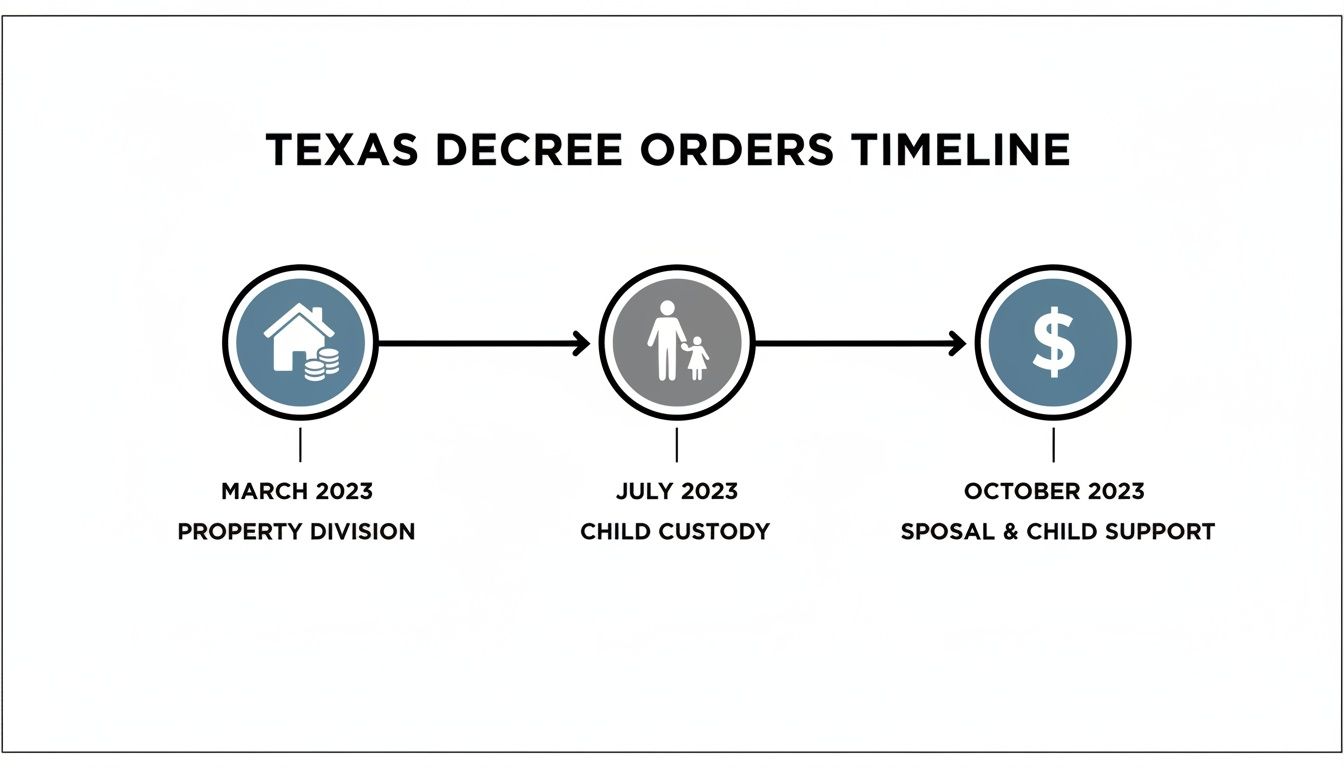
As you can see, every part of your case moves along a set path that ends with that final, appealable order.
The Trial Court's 30-Day Plenary Power
Under Texas rules, a trial judge retains plenary power for 30 days after signing the final decree. During this brief period, the judge can still modify, correct, or even withdraw the original decree. This is the window to file post-judgment motions, like a Motion for New Trial, asking the judge to reconsider the decision.
This power is absolute but temporary. Once those 30 days expire, the trial court loses all jurisdiction. The judgment is final for that court, and the only way to correct a major legal error is through the court of appeals.
Navigating Strict Appellate Deadlines
The deadline to begin an appeal is tied directly to the date the decree is signed. You have just 30 days from the judgment date to file a Notice of Appeal. This is a straightforward but essential document that informs the court and the other party of your intent to challenge the ruling. You can learn more about this crucial first step by reading our guide on what a Notice of Appeal is.
If you file a Motion for New Trial or another qualifying motion within that first 30-day period, the deadline to file your Notice of Appeal is extended to 90 days from the date the original decree was signed.
Key Takeaway: The deadlines for filing post-judgment motions and a Notice of Appeal are mandatory and unforgiving. This is why you must contact an appellate attorney the moment you receive a decree you believe is unjust.
These post-decree timelines are the final chapter of a process that starts much earlier. Texas has a mandatory 60-day waiting period, so a final decree cannot be signed for at least two months after a case is filed. This entire journey funnels down to that critical 30-day (or 90-day) window to preserve your rights.
Identifying Reversible Error in a Texas Divorce Appeal
You might feel the judge simply didn't understand your situation. While that frustration is valid, an appeal is not a second chance to tell your story or present new evidence. A successful appeal depends on proving the trial court made a significant legal mistake, known as a "reversible error."
Our role as appellate attorneys is to meticulously review the trial record—every transcript, exhibit, and ruling—to pinpoint these specific errors. The goal is not to re-argue the facts but to demonstrate to a higher court that the judge misapplied the law or made a decision so flawed that it led to a wrong and unjust outcome.
Understanding the Standard of Review in Family Law
Most decisions in Texas family law are reviewed under an "abuse of discretion" standard. This is a critical concept for anyone considering an appeal.
Plain-English Definition: Abuse of Discretion occurs when a trial judge makes a decision that is arbitrary, unreasonable, or without reference to any guiding legal rules or principles. It’s not just about disagreeing with the outcome; it’s about proving the judge's reasoning was legally flawed.
To win an appeal, we must convince the higher court that the judge’s mistake was not minor but a critical error that likely caused an improper judgment in your final divorce decree in Texas.
Common Reversible Errors in Texas Family Courts
While every case is unique, certain judicial mistakes frequently form the basis for successful appeals. Identifying them requires a deep knowledge of the Texas Family Code and the rules of evidence and procedure.
Here are examples of common reversible errors:
- Mischaracterization of Property: The court wrongly classifies separate property (like an inheritance or pre-marital business) as community property and divides it. This is a direct violation of Texas property law.
- Improper Valuation of Assets: A judge uses outdated or incorrect information to value a major asset, such as a family business or real estate, resulting in a lopsided and unfair property division.
- Incorrect Application of Child Support Guidelines: The court deviates from the standard child support formula without providing the legally required justification, leading to an incorrect support amount.
- Ignoring Key Evidence in a Custody Case: The judge refuses to consider critical evidence of family violence, substance abuse, or other factors relevant to the child’s best interest.
- Procedural Errors: The court makes a procedural mistake, such as denying you the right to present essential evidence or testimony, which prevents a fair trial.
These are not minor grievances. Each represents a potential failure of the court to follow the law. You can learn more about specific grounds for appeal in Texas family court in our detailed guide. Recognizing the difference between an unfavorable result and a legally flawed one is the first step toward seeking justice.
Modification vs. Appeal: Choosing the Right Path After Divorce
Once your final divorce decree is signed, life moves on. It is a common misconception that appealing is the only option if something is not right with your decree. An appeal looks backward to correct a mistake made in the past based on the evidence presented at trial. Most post-divorce issues, however, are about the future.
If your ex-spouse is not following the rules—for example, failing to pay child support or denying visitation—you need a Motion for Enforcement to ask the judge to compel compliance.
But when circumstances change significantly, a Petition to Modify is the appropriate tool. This is the correct path when there has been a "material and substantial change" in your family's situation, making the old orders for your children or financial support unworkable.
When to Modify Your Decree
Filing for a modification is like starting a new, focused lawsuit. You are not arguing the original decree was wrong; you are arguing that it was right for its time, but that circumstances have changed so much that the old order no longer serves your child's best interests.
Common reasons for modification include:
- A Major Shift in Income: A parent loses a job or receives a significant promotion.
- Relocation: One parent plans a long-distance move, making the current visitation schedule impractical.
- A Child's Needs Change: A child develops new medical or educational needs that impact support or custody.
- Remarriage: A new marriage, combined with other factors, can justify a change.
Crucially, the property division in your decree is almost always final. You cannot modify how assets and debts were divided. Modifications are almost exclusively for ongoing issues like custody, visitation, and child support.
The Core Difference: Appeal vs. Modification
Understanding this distinction is key to moving forward effectively.
An appeal argues, "The judge made a legal error at trial, based on the evidence presented back then."
A modification argues, "Things are so different for our family now that the old rules no longer fit our new reality."
While divorce rates fluctuate—you can read about these changing divorce statistics at Divorce.com—the legal challenges families face post-divorce remain. Choosing the right path—appeal, modification, or enforcement—is essential to protecting your rights and your family's future.
Your Next Steps When Facing an Unfair Decree
Reading a final divorce decree that feels deeply unfair can be incredibly disheartening. You may feel like the emotional and financial effort of your divorce was for nothing. But it’s crucial to understand this might not be the last word.

You have options, but the clock is ticking. The deadlines for challenging a court's judgment in Texas are strict and unforgiving. To seek a fair outcome, you must take strategic action immediately.
Scheduling a Consultation
Your first step should be to schedule a consultation with an attorney who focuses on Texas family law appeals. This is a specialized field that differs significantly from trial work. You need an advocate trained to spot reversible error, not just re-argue your case. An experienced Texas family law appeal attorney can provide a realistic assessment of your chances of overturning the decision.
An appeal is not a "do-over" of your trial. The objective is to prove that the trial judge made a serious legal mistake that resulted in an unjust outcome.
To make the most of your first meeting, come prepared. Gathering key documents beforehand will help your appellate lawyer evaluate your case more effectively.
Assembling Your Case File for Review
Before meeting with an attorney, try to gather the core documents that will form the basis of any potential appeal:
- The Final Divorce Decree: This is the most important document. Ensure you have the complete, signed, and file-stamped copy of the order.
- Key Trial Evidence: Collect major items from your trial, such as property inventories, business valuations, expert reports, or critical exhibits.
- The Reporter's Record: This is the word-for-word transcript of the trial. Your appellate attorney can order this for you.
- The Clerk's Record: This is the complete collection of every document filed in your case.
Taking these deliberate steps is empowering. By consulting a specialist and organizing your records, you are taking back control and seeking to restore fairness.
Frequently Asked Questions About Texas Divorce Appeals
After a final decree is issued, it is natural to have questions, especially if you feel the outcome was unjust. Here are plain-English answers to some common concerns about appealing a divorce in Texas.
How Long Do I Have to Appeal a Divorce Decree in Texas?
The appellate clock starts the moment the judge signs the final decree. You typically have only 30 days to file a Notice of Appeal. This deadline is strict.
However, if you file a specific post-judgment motion, such as a Motion for New Trial, within that initial 30-day window, the appeal deadline can be extended to 90 days from the signing date. Because these timeframes are critical, you must speak with an appellate lawyer immediately to preserve your right to challenge the ruling.
Can My Ex-Spouse and I Agree to Change the Decree Ourselves?
No. While cooperation is encouraged, a private agreement will not legally change the court's order. For any changes to be enforceable, you must go back to court and have a judge sign a new, agreed order. This is a common process for modifying future obligations like child custody or support. However, the property division in your final decree is almost always final and cannot be altered, even by agreement.
What's the Difference Between an Appeal and a Modification?
This is a key distinction based on timing and purpose.
An appeal looks backward. You are asking a higher court to correct a serious legal error the trial judge made during the original case, based on the evidence that existed at that time.
A modification looks forward. It is a new lawsuit asking the court to change the order due to a "material and substantial change" in circumstances since the decree was signed. An appeal challenges an old mistake; a modification addresses new facts.
Plain-English Definition: "Briefing"
In an appeal, "briefing" refers to the process of writing and submitting detailed legal arguments to the appellate court. These documents, called briefs, are where your attorney explains the trial court's reversible errors, citing legal precedent and the trial record to persuade the higher court to reverse the decision. This written advocacy is the core of the appellate process.
If you believe the court made a mistake in your family law case, our appellate attorneys can help you seek a fair outcome. Contact The Law Office of Bryan Fagan today for a free consultation at our family law appeals website.