You may feel your case was handled unfairly, especially when it comes to the court's decision on financial support. In Texas, the amount of alimony—or what the law calls spousal maintenance—is very tightly controlled. A court can only order payments up to $5,000 per month or 20% of the paying spouse's average gross monthly income, whichever is less. This strict cap means that many people who feel they need support won't qualify, or the amount they receive might not feel like enough to get by. If a judge's ruling on this issue seems wrong, you have the right to seek justice.
Understanding Texas Spousal Maintenance and Its Strict Limits
If you're going through a divorce and the judge's decision on financial support feels unjust, you have every right to question it. Texas has some of the most restrictive spousal maintenance laws in the country. In fact, our legal system starts with the assumption that maintenance isn't necessary.
Before a judge can even think about ordering payments, the spouse asking for help has to clear a high hurdle. They must first prove they cannot meet their "minimum reasonable needs" on their own, even after accounting for the property they were awarded in the divorce. That's a tough standard to meet, and it's just the beginning.
The Strict Caps on Payment Amounts
Texas law leaves very little wiggle room on how much maintenance can be ordered. Compared to other states, Texas is an outlier with its rigid caps.
This limit—the lesser of $5,000 a month or 20% of the paying spouse's gross monthly income—was designed to prevent lifelong financial dependency. However, it has a massive impact on divorcing couples. To put it in perspective, Texas saw over 80,000 divorces in 2022 alone, but only a small fraction ever qualify for this type of support because the eligibility rules are so tough.
For a deeper dive into the numbers and requirements, you can check out this helpful video about spousal maintenance in Texas.
To give you a quick reference, here’s a snapshot of the core rules that define spousal maintenance in our state.
Texas Spousal Maintenance At A Glance
| Factor | Texas Law Summary |
|---|---|
| Maximum Amount | The lesser of $5,000/month or 20% of the paying spouse's average monthly gross income. |
| Initial Presumption | Texas courts presume that spousal maintenance is not warranted. |
| Eligibility Prerequisite | The requesting spouse must first prove they cannot meet their "minimum reasonable needs." |
| Primary Qualification | The marriage must have lasted 10 years or longer, and the spouse seeking support must lack the ability to earn a sufficient income. |
| Family Violence Exception | The 10-year rule can be waived if there has been a conviction or deferred adjudication for an act of family violence. |
These statutory limits are the bedrock of every spousal maintenance case in Texas. When they aren't followed precisely, it opens the door for an appeal.
What You Can Appeal in a Spousal Maintenance Case
These rigid rules—from who is eligible to how much they can receive—are fertile ground for mistakes at the trial court level. When a judge fails to correctly apply these laws, it can be considered an abuse of discretion. This isn't just a simple disagreement; it's a specific type of legal error that an appellate court can fix.
It's important to remember that an appellate court doesn't re-try the case or listen to new testimony. Instead, it carefully reviews the trial record to see if the law was followed correctly.
Abuse of Discretion: This legal term describes a situation where a trial court's decision was unreasonable, arbitrary, or made without considering the guiding legal rules. Awarding maintenance above the statutory cap or granting it to a spouse who clearly doesn't qualify are perfect examples.
Grasping these foundational rules is the first step toward spotting a potential reversible error in your divorce decree. A mistake in applying these strict financial limits can have lasting consequences, but a well-handled appeal offers a pathway to a fair and legally correct result. To learn more about the fundamentals, you might be interested in our guide that asks, "What is spousal support in Texas?"
Proving You're Eligible for Spousal Maintenance
It can be disheartening when a court denies financial support, especially if you've spent years putting your family first. In Texas, getting what's legally called "spousal maintenance" isn't automatic—far from it. The law sets a very high bar, and it's one of the most common areas where trial courts get it wrong, creating a solid foundation for an appeal.
The Texas Family Code lays out a crucial two-part test. The first step is universal: the spouse asking for support must prove they don't have enough property (including what they get in the divorce) to provide for their "minimum reasonable needs."
The First Hurdle: Proving You Can't Meet Your Minimum Reasonable Needs
Before a judge can even think about awarding maintenance, you have to open up your books and show that you are financially underwater. The court will comb through your entire financial picture—your separate property, the community property you're awarded, any income—to see if you can cover basic living expenses. We're talking about essentials like rent or a mortgage, utilities, food, and transportation.
Think of it as a bare-bones budget. If your necessary monthly expenses are more than your income and any assets you could reasonably tap into, you’ve cleared the first hurdle. When a trial court glosses over this financial analysis or gets the numbers wrong, it can amount to an abuse of discretion—a clear error that's ripe for an appeal.
The Second Hurdle: Finding Your Qualifying Path
Proving you need the money is only half the battle. After that, you must also fit into one of the specific scenarios laid out by the law. Simply being in a tough spot financially isn't enough to qualify.
Here are the four specific gateways to eligibility:
- The 10-Year Marriage Rule: This is the most common path. The marriage must have lasted 10 years or longer, and you have to show you've made a real effort to either earn enough money or get the skills to do so, but still can't make ends meet.
- The Family Violence Exception: This applies if your spouse was convicted of (or received deferred adjudication for) an act of family violence against you or your child. The act must have happened within two years of filing for divorce or while the case was ongoing.
- The Disability of a Spouse: You can qualify if you have an incapacitating physical or mental disability that keeps you from earning enough to cover your basic needs.
- The Disability of a Child: This path is for parents who are the primary caregiver for a child of the marriage (of any age) who has a disability requiring such substantial, personal care that it prevents the parent from working.
This flowchart breaks down the two most common routes—the 10-year rule and the family violence exception.
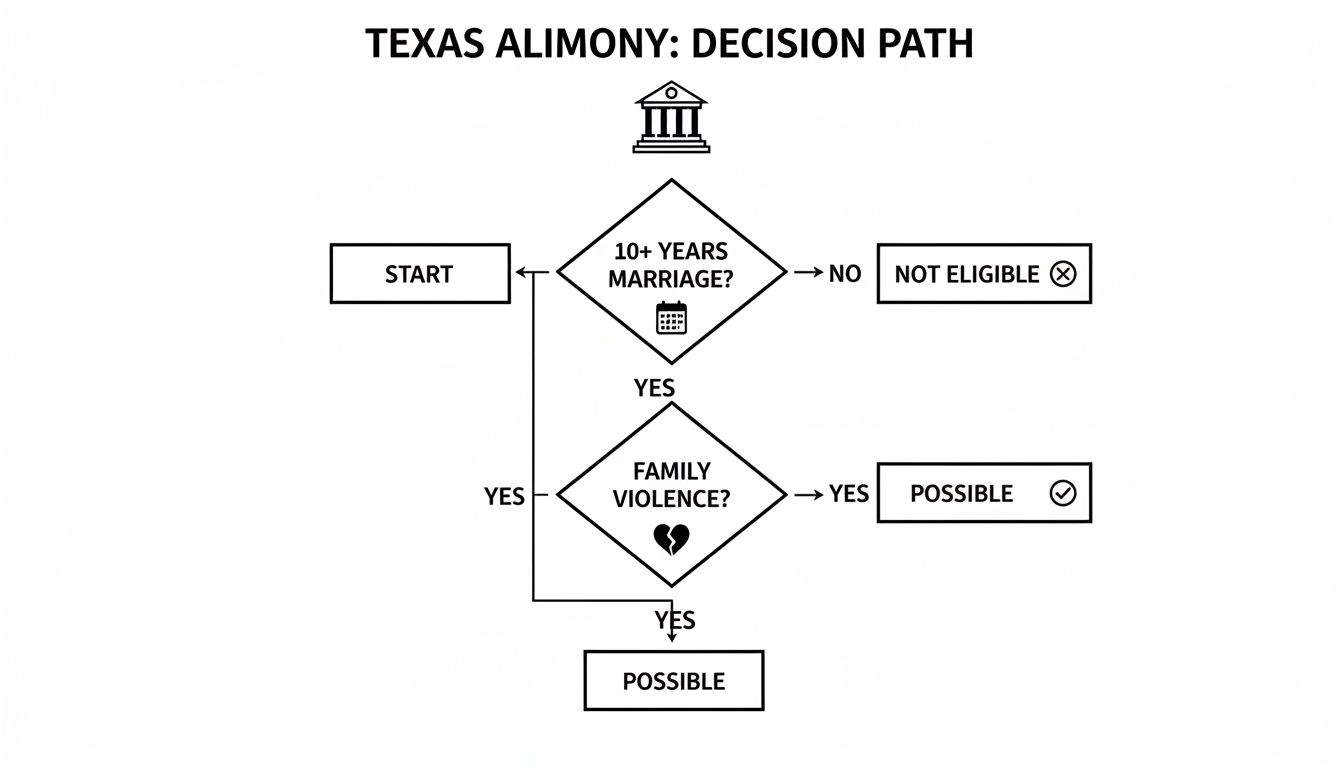
As you can see, even if you weren't married for a decade, a proven history of family violence can create a path to eligibility.
Why Getting These Rules Right is Critical for an Appeal
Each of these requirements is loaded with specific legal definitions and demands hard evidence. What does a "diligent" job search actually look like in the eyes of the court? How do you legally prove a disability is "incapacitating"? If a trial court botches the interpretation of the evidence or misapplies one of these strict rules, it's often a reversible error.
Reversible Error: Think of this as a mistake made during a trial that was so significant it likely changed the final outcome. When an appellate court spots a reversible error, it can overturn the original decision and send the case back to be decided correctly.
This is where our appellate attorneys dig in. We meticulously review the trial record to see if the judge correctly applied both parts of this demanding eligibility test. If the evidence was there but the court denied maintenance—or if it awarded maintenance when the legal requirements clearly weren't met—you may have a very strong case for an appeal.
For a deeper dive, you can explore our guide that answers the question, "Can you get alimony in Texas?"
The Guardrails: How Much and How Long?
Even if a spouse clears the high bar to qualify for maintenance, the court doesn’t get a blank check. Texas law puts very strict, non-negotiable caps on both the dollar amount and the duration of payments. If you’ve ever looked at a divorce decree and felt the judge just picked a number out of thin air, your gut might be right—and that’s often where an appealable error is hiding.
An error in these calculations isn’t just a minor oversight; it’s a direct misapplication of the Texas Family Code. When a judge orders payments that blow past these statutory maximums, it’s typically considered an abuse of discretion, which is solid ground for an appeal. Our job as appellate attorneys is to put that final order under a microscope and ensure these rigid financial rules were followed to the letter.
The Two Hard Caps on Payment Amounts
The law sets two different ceilings on monthly maintenance payments. The key is that a judge must award the lesser of the two. This is a critical point that, frankly, gets mixed up in trial courts more often than you’d think.
Here are the two caps:
- $5,000 per month: This is the absolute maximum, no matter how much the paying spouse earns.
- 20% of the paying spouse’s average monthly gross income: This isn’t just about salary. The calculation has to include all sources of income—bonuses, commissions, rental income, you name it.
A court simply cannot order more than whichever of those two figures is smaller.
Let's walk through a real-world example. Say the paying spouse earns $30,000 a month. 20% of that is $6,000. But because $6,000 is more than the $5,000 hard cap, the absolute maximum the judge can award is $5,000.
Now, flip it. If the paying spouse earns $10,000 a month, 20% of that is $2,000. Since $2,000 is less than the $5,000 cap, the maximum possible award in this case is $2,000.

How Marriage Length Dictates the Payment Calendar
The duration of spousal maintenance is just as tightly regulated as the dollar amount. The law ties the maximum length of payments directly to how long the couple was married. These aren't guidelines; they are hard stops.
A surprisingly common reversible error is when a trial court orders maintenance for longer than the statute allows. For example, ordering seven years of payments for a 15-year marriage is a clear legal mistake and a textbook reason for an appeal.
It's important to remember that Texas maintenance awards are rare to begin with, granted in fewer than 10% of divorces. This reflects a major shift from national averages of 25% in the mid-20th century, a direct result of reforms passed in 1995 designed to prioritize short-term, rehabilitative aid. The limits outlined in the Texas Family Code §8.051-8.304 are ironclad, with durations strictly pegged to the marriage's tenure. You can dive into historical divorce data to see just how much these legal trends have evolved.
Here is a simple breakdown of the maximum timeframes a judge can order, based on the length of the marriage.
Maximum Spousal Maintenance Duration By Marriage Length
| Length of Marriage | Maximum Duration of Maintenance Payments |
|---|---|
| 10 to 20 years | 5 years |
| 20 to 30 years | 7 years |
| 30 years or more | 10 years |
While there are some narrow exceptions for situations involving a disabling condition, for the vast majority of cases, these time limits are absolute.
If the final order in your case exceeds these legal caps—on either the amount or the duration—it’s not a matter of judicial opinion. It’s a legal mistake. Our appellate team specializes in spotting these precise errors, building a powerful argument based on the plain language of the law, and making a compelling case to the court of appeals to set things right.
How Courts Weigh the Key Factors for an Award
Even if a spouse clearly qualifies for maintenance and the judge knows the maximum dollar amounts allowed, the process is far from automatic. A Texas judge can't just pick a number out of a hat. The Texas Family Code lays out a specific roadmap of factors that the court must consider to arrive at a fair and just award, looking at both the amount and how long it should last.
This is a critical part of the process. If you believe the judge in your case glossed over important evidence or didn't properly balance these factors, you might be right. A court's failure to correctly weigh this evidence can be a clear abuse of discretion—and that’s often the strongest ground for an appeal.

Financial and Personal Circumstances
The court’s first job is to get a realistic picture of each spouse's financial life after the divorce. This isn't a surface-level glance; it's a deep dive into each person's ability to cover their own "minimum reasonable needs."
- Financial Resources: The judge looks at the property each spouse walks away with from the divorce. This includes their share of community property, but also any separate property, retirement funds, or cash on hand.
- Education and Employment Skills: The court evaluates each spouse's education, work history, and true potential to earn a living. A spouse with a recent marketable degree is in a very different position than one who’s been out of the professional world for 20 years raising children.
This analysis is about more than just what's on a spreadsheet; it's about each person's genuine capacity to be self-supporting. If a judge ignores that one spouse has a massive separate property inheritance or fails to consider clear evidence of their high earning potential, that could be a reversible error.
Contributions and Conduct During the Marriage
Next, the court looks back at the marriage itself, weighing both the good and the bad. This step is designed to ensure the final maintenance award reflects the reality of the partnership.
- Contributions as a Homemaker: The law rightfully recognizes the immense value of a spouse who managed the household and cared for the children, which directly enabled the other spouse to build a career.
- Contributions to the Other's Career: This could be a spouse who worked full-time to put their partner through medical school or supported them through the risky early years of starting a business.
- Marital Misconduct: A judge can absolutely consider actions like adultery or cruel treatment. Evidence that one spouse deliberately wasted or hid community money (dissipation of the marital estate) can also tilt the scales significantly.
These aren't just items on a checklist. The judge has to carefully balance them to craft a result that is genuinely fair.
A Tale of Two Scenarios
Let's see how these factors play out in the real world. Imagine two different couples, both divorcing after a 25-year marriage where the wife is seeking spousal maintenance.
Scenario A: The wife was a dedicated homemaker who raised four children, freeing up her husband to build a multi-million dollar company. She has no recent work experience. During the divorce, bank statements prove the husband spent tens of thousands from their joint account on an affair. Here, a court would likely give significant weight to her non-financial contributions and his misconduct, pushing the maintenance award toward the statutory maximum.
Scenario B: The wife was also a homemaker, but she has a master's degree and worked as a CPA before their children were born. The divorce is amicable, with no fault alleged by either side. In this case, while her role as a homemaker is still valued, the court will also weigh her high earning potential. This might lead to a shorter maintenance duration or a lower amount, structured to help her re-enter the accounting field.
Abuse of Discretion: This is a key legal term. It means a trial judge made a decision that was unreasonable, arbitrary, or without reference to the guiding legal rules. If a judge ignores clear evidence of a spouse's ability to work (like in Scenario B) or downplays significant marital fault (like in Scenario A), that decision may be an abuse of discretion—and a prime candidate for an appeal.
Filing an appeal isn't just about being unhappy with the final number. It’s about proving the judge failed to follow the legally required process of weighing the evidence. When a court's final order seems completely disconnected from the facts presented in the courtroom, our appellate team knows how to comb through the record to see if an appeal can deliver the just outcome you deserve.
What to Do When a Spousal Maintenance Order Is Unfair
If you're looking at a spousal maintenance order that feels fundamentally wrong, you're not out of options. The Texas legal system has a built-in process for challenging these decisions: an appeal. But it's crucial to understand that an appeal is not a second trial. You cannot bring in new witnesses or evidence.
An appeal is a focused review of what happened in the trial court to determine if the judge made a significant legal mistake. Our job as appellate attorneys is to meticulously comb through every transcript, document, and ruling to pinpoint specific errors that led to an unjust outcome for you.
Understanding the Standard of Review and Reversible Errors
A successful appeal hinges on identifying a specific kind of mistake known as a reversible error—an error so critical that it likely caused the judge to make the wrong decision.
In spousal maintenance cases, these errors tend to fall into a few common categories:
- Exceeding Statutory Caps: The court ordered payments beyond the legal limit of $5,000 per month or 20% of the paying spouse's gross monthly income.
- Violating Time Limits: The judge awarded maintenance for a duration longer than the law allows for the length of your marriage (for instance, ordering seven years of payments for a 15-year marriage).
- Ignoring Crucial Evidence: The court failed to consider clear proof of a spouse's ability to earn a good income or their access to significant separate property when determining their "minimum reasonable needs."
- Misapplying Eligibility Rules: The judge granted maintenance to a spouse who did not qualify under the law, such as not meeting the 10-year marriage requirement without a valid exception.
When a judge makes one of these kinds of mistakes, we call it an abuse of discretion. This isn’t just about disagreeing with the final number. It’s a legal term that means the court made a decision without following the established legal rules and principles.
Abuse of Discretion: This is the standard of review appellate courts use for many family law decisions. It means the trial judge's decision was unreasonable, arbitrary, or made without any real consideration of the facts and the law. Proving this is at the heart of most spousal maintenance appeals.
You have to remember, Texas has always been reluctant to award lifetime support, preferring to divide property to create a clean break. The modern law, updated in 2011, still reflects this caution with its strict caps. An appeal often boils down to showing how the trial court abused its discretion by not following these strict limits.
Step-by-Step Insights on the Appeals Process
Starting an appeal is a race against the clock, governed by the strict Texas Rules of Appellate Procedure. The process begins the moment the judge signs the final divorce decree.
The very first step is filing a Notice of Appeal. This is the formal document that tells the court and the other side you plan to challenge the ruling. For most cases, you have just 30 days from the date the judgment is signed to get this filed. If you miss that deadline, your right to appeal could be lost.
Once the notice is filed, the work of assembling the official trial record begins. This involves gathering the Clerk’s Record (every document filed in your case) and the Reporter’s Record (the official, word-for-word transcript of everything said in court). This record is everything. It's the only evidence the appellate court will look at, which is why we scrutinize it so carefully to build the strongest possible argument for a reversible error. For more background on this topic, our guide on how much is spousal support in Texas can provide additional context.
Frequently Asked Questions About Texas Alimony
When you're in the middle of a divorce, the rules around spousal maintenance can feel like a maze. It’s a stressful time, and confusing legal standards don't help. Let's clear up some of the most common questions we hear from clients, especially those who feel the court got their maintenance order wrong.
Can I Get Alimony If My Marriage Was Under 10 Years?
Usually, the answer is no. Texas law generally requires a marriage to have lasted at least 10 years before a judge can even consider ordering spousal maintenance. It’s a firm prerequisite.
But there's a crucial exception. The 10-year rule gets thrown out the window if the paying spouse was convicted of (or got deferred adjudication for) an act of family violence. This exception applies if the violence happened within two years of the divorce filing or while the divorce was ongoing. It's a powerful provision that trial courts sometimes miss, potentially creating a strong point for an appeal.
Is Temporary Support the Same as Spousal Maintenance?
This is a common point of confusion, but they are completely different. Think of them as serving two separate purposes at two different times.
- Temporary Spousal Support: This is money ordered by the judge to be paid while the divorce is pending. It’s a short-term solution designed to keep the lights on and help a lower-earning spouse stay afloat financially until the case is over.
- Spousal Maintenance: This is the support paid after the divorce is final. It’s the long-term alimony that has to meet all the strict eligibility rules, caps, and time limits we've covered.
When we talk about an appeal, we're almost always challenging the final spousal maintenance award in the divorce decree, not the temporary support paid along the way.
Are Alimony Payments Taxable?
Not anymore, and this change has big financial implications. For any divorce finalized after December 31, 2018, the federal tax law is straightforward: spousal maintenance payments are not deductible for the person paying them, and they are not considered taxable income for the person receiving them.
This is a huge deal. A trial court that fails to consider these tax consequences when crafting a financial award might be making a reversible error. The "real-world" value of the support is directly affected, and that can absolutely be an issue on appeal.
Can a Spousal Maintenance Order Be Changed?
Yes, but it isn't easy. A final spousal maintenance order can be modified or even terminated down the road, but you have to go back to court and prove a "material and substantial change" in either party's circumstances.
What does that mean in practice? Here are a few real-world examples:
- The paying spouse loses their job through no fault of their own.
- The receiving spouse lands a great new job and no longer needs the support.
- Either person suffers a serious health issue that impacts their ability to earn a living.
Of course, maintenance also ends automatically if the receiving spouse remarries or if either person passes away. If you tried to modify an order and believe the judge made the wrong call—or if the other side did and you think the judge got it wrong—that decision could be grounds for an appeal.
If you believe the court made a mistake in your family law case, our appellate attorneys can help you seek a fair outcome. Contact The Law Office of Bryan Fagan today for a free consultation.