You may be dealing with a temporary custody order that changed your parenting time overnight, limited contact with your child, or gave the other parent control in a way that feels legally wrong. In that moment, many parents ask the same question: can I appeal this now?
In Texas, the answer is usually no if the order is temporary. But that doesn’t mean you have no option. In the right private custody case, an emergency mandamus may be the tool that asks an appellate court to step in before the damage becomes harder to undo.
Many online explanations frequently fall short. They often focus on DFPS removals or state intervention cases. Private parent-versus-parent cases are different. The strategy, the record, and the legal theory all have to be tighter.
Understanding Emergency Mandamus in Texas Custody
A writ of mandamus is an order from an appellate court directing a trial judge to correct a legal error. It is not a new trial. It is not a chance to offer new evidence. It is a focused request for extraordinary relief based on the record that already exists.
In plain English, a normal appeal usually happens after the case is over. Mandamus is what you look at when waiting until the end of the case would leave you without a meaningful remedy. That’s why it comes up so often with temporary custody rulings.
Why temporary custody orders create this problem
Texas family courts often enter temporary orders to control custody, possession, exchange terms, and parental decision-making while the case is still pending. Those orders can shape your day-to-day relationship with your child for a long time, even though they are not final.
That creates a hard reality. A parent may be living under an order that feels unfair, yet the normal appellate path is not available at that stage. Mandamus exists to address that gap.
A mandamus petition is not a second argument about why the judge should have believed you. It is a legal challenge to a ruling that crossed a line the law does not allow.
What emergency mandamus custody Texas usually means in practice
When people search for emergency mandamus custody Texas, they are usually talking about a private SAPCR case or custody modification dispute between parents. They are not talking about a CPS removal. That distinction matters.
Private custody mandamus work often centers on whether the trial court ignored a legal limit, applied the wrong legal standard, or acted without proper jurisdiction. In modification cases under Texas Family Code §156.006, a parent may need to show more than unfairness. The parent must show a real legal defect, such as a jurisdictional problem under the UCCJEA, which can support mandamus relief in the right case, as discussed in this analysis of private custody mandamus issues.
Key terms you need to understand
A few appellate terms matter immediately in this area:
- Abuse of discretion means the trial court made a ruling outside the legal bounds that govern its decision. In family law, judges have discretion on many matters. But they do not have discretion to apply the wrong law.
- Reversible error means a legal mistake serious enough to justify appellate relief.
- Briefing means the written legal argument filed in the appellate court. In mandamus practice, the written petition does most of the work.
- Record means the materials from the trial court, usually the clerk’s record and reporter’s record, that show exactly what happened.
Mandamus compared to an ordinary appeal
| Attribute | Writ of Mandamus | Standard Appeal |
|---|---|---|
| When used | During a pending case, often to challenge temporary orders | After a final order or judgment |
| Purpose | Correct an extraordinary legal error immediately | Review final judgment for reversible error |
| New evidence allowed | No | No |
| Main focus | Clear legal error and no adequate remedy by appeal | Preserved error in the final case outcome |
| Speed | Faster in theory, but highly selective | More structured and predictable |
| Typical custody use | Temporary custody, jurisdictional errors, legal violations in interim rulings | Final SAPCR or divorce orders |
What works and what doesn’t
What works is a narrow, disciplined argument tied to a rule, statute, or clear legal duty. What usually fails is a petition that says the judge was unfair, ignored your side, or made the wrong call on disputed facts.
That difference is hard for parents because family hearings are emotional and fact-heavy. But appellate courts are not reweighing the hearing the way a trial judge does. They are asking whether the law was violated in a way that justifies extraordinary intervention.
If your complaint is, “The judge believed the other parent instead of me,” mandamus is usually weak. If your complaint is, “The judge entered a temporary custody ruling without legal authority, ignored a mandatory procedure, or acted despite a jurisdictional defect,” the analysis changes.
The High Legal Standard for Mandamus Relief
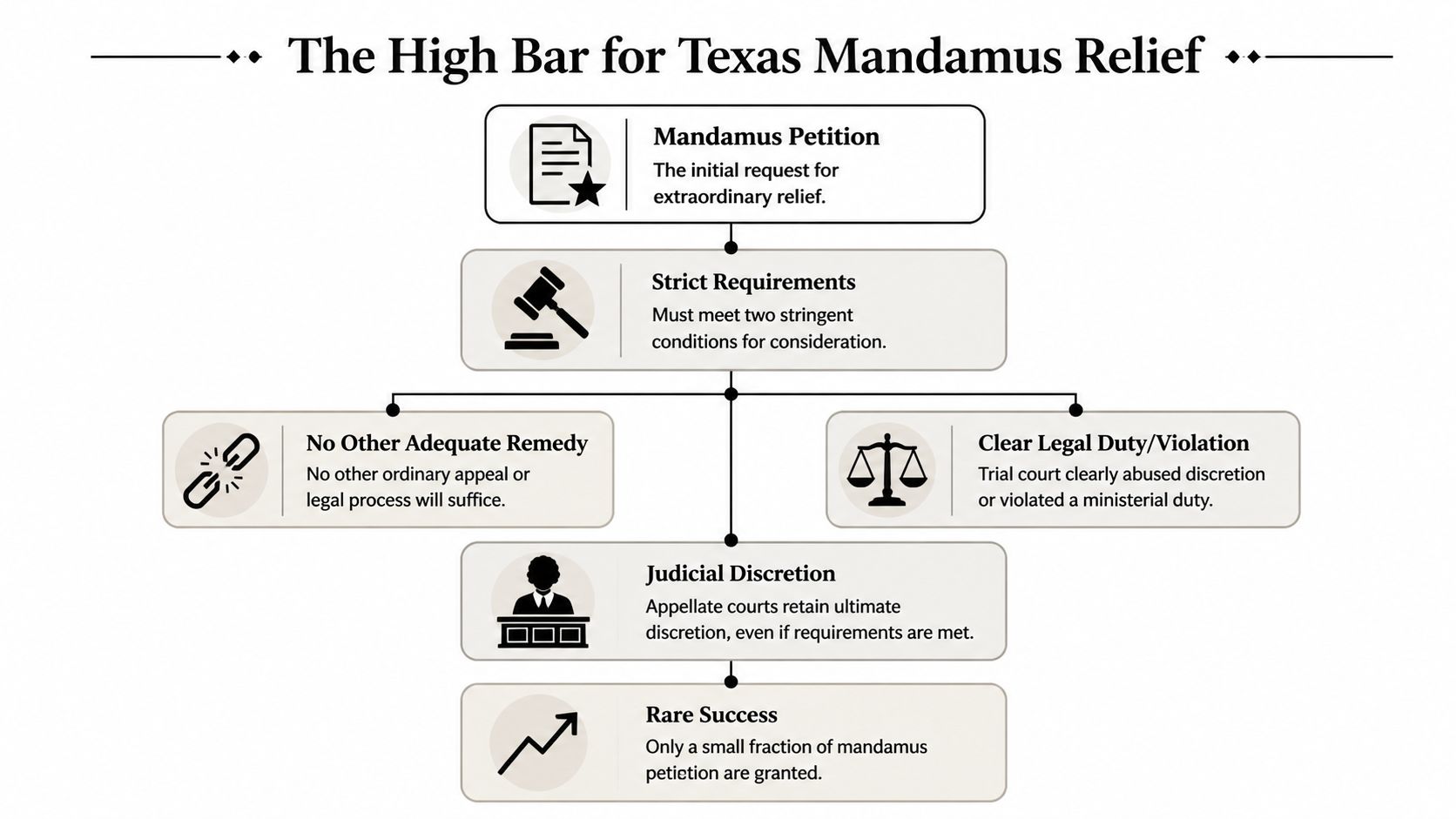
Mandamus is available in Texas, but courts treat it as an exceptional remedy. That is not just a phrase lawyers repeat. It shows up in the numbers and in how courts screen these petitions.
Texas Supreme Court data shows mandamus grant rates ranging from 3.0% to 9.5% in recent fiscal years, confirming how rarely courts grant this relief. The same data reflects a filtering effect that eliminates 91% to 97% of petitions before relief is granted, as discussed in the SMU review of Texas mandamus practice.
The two core requirements
A strong mandamus petition usually has to prove two things.
First, the trial court committed a clear abuse of discretion or violated a legal duty it was required to follow.
Second, the parent has no adequate remedy by appeal. That point matters in temporary custody disputes because waiting for a final order may not repair lost time, disrupted stability, or a legally defective interim arrangement.
Some emergency requests also need to show why immediate action is necessary to prevent harm that cannot be fixed later. In practical terms, the appellate court wants to know why this issue cannot wait.
What abuse of discretion really means
Parents often hear this phrase and assume it means the judge made a bad choice. That is too broad. An appellate court is not asking whether another judge could have ruled differently.
It is asking whether the ruling departed from the controlling law or guiding legal principles. That distinction is everything in mandamus practice.
Practical rule: Disagreement is not enough. Legal error is the currency that matters.
Why private custody petitions are difficult
In a private SAPCR dispute, many temporary rulings sit in the gray zone between law and discretion. Judges have room to assess credibility, weigh competing testimony, and make temporary calls. That means many complaints are really challenges to a discretionary judgment, not to a legal violation.
A better petition identifies something more exact:
- A jurisdictional defect that should have stopped the court from acting
- A failure to apply the correct statute
- A refusal to perform a required act
- A temporary order that exceeds the legal authority given to the court
That is why issue selection matters more than volume. A shorter petition with one clean legal ground is often stronger than a sprawling filing with ten complaints.
The urgency problem
Parents often assume that if a custody issue is urgent emotionally, it is urgent legally. Sometimes that is true. Sometimes it is not.
Appellate courts look for urgency tied to law and remedy. They want to know why ordinary trial-court proceedings or a later final appeal won’t fix the problem. If the petition doesn’t answer that clearly, it often fails before the court ever reaches the deeper issue.
For a fuller look at how this remedy functions in family cases, review this guide on mandamus in a Texas family law case.
A realistic mindset helps
Mandamus is not hopeless. But it is selective. The low grant rates should not scare a parent away from a valid petition. They should force a disciplined review of whether the case involves a true legal emergency rather than a painful but ordinary temporary ruling.
That sober analysis is often the turning point. Some cases need immediate appellate action. Others need a different strategy in the trial court.
Building a Compelling Case for Mandamus
A mandamus petition rises or falls on the record. If the legal error is not documented, the appellate court cannot fix it. That is why the first real task is not writing. It is collecting and organizing the materials that prove what happened.

Start with the right record
In most custody mandamus matters, two parts of the record do the heavy lifting:
- Clerk’s record. This includes pleadings, motions, responses, exhibits filed with the clerk, and the signed order.
- Reporter’s record. This is the transcript of the hearing, including objections, rulings, testimony, and argument.
If your issue involves what the judge said or how the hearing unfolded, the reporter’s record is often essential. If your issue is visible from the pleadings and the signed order alone, the clerk’s record may carry more weight.
A weak petition often has one of two record problems. Either the relator filed too fast and omitted key materials, or the relator filed too loosely and attached piles of papers without a coherent theory.
The best arguments are usually legal, not emotional
The strongest mandamus petitions often rely on a ministerial duty theory. That means the judge had no discretion and was required by law to act in a specific way. Texas courts also hold that a trial judge has no discretion in correctly interpreting and applying the law, so a clear legal error can qualify as an abuse of discretion, as explained in this discussion of mandamus relief in Texas family law cases.
That distinction matters because many parents naturally frame the case this way: “The judge got it wrong.” Appellate courts need something sharper: “The judge had no lawful authority to do this,” or “The judge applied the wrong legal rule.”
A practical checklist for evaluating viability
Before drafting a petition, it helps to pressure-test the case with concrete questions:
What exact ruling is being challenged?
Identify the signed order, the hearing date, and the part of the ruling causing immediate harm.Where is the legal error?
Point to the statute, rule, or jurisdictional principle the trial court violated.Is the error preserved in the record?
Show whether counsel objected, raised the issue, requested relief, or otherwise made the complaint clear.Why won’t a final appeal fix it?
Explain why waiting is not an adequate remedy in this specific custody dispute.What emergency relief is needed?
Ask for targeted relief. Overreaching hurts credibility.
A compelling mandamus petition reads like a clean chain of proof. The court should be able to follow the legal problem from motion, to hearing, to ruling, to harm without guessing.
Abuse of discretion versus ministerial duty
At this stage, many petitions break down.
If the issue is ministerial duty, the argument is usually stronger because the court had a required legal path and failed to follow it. If the issue is abuse of discretion, the petition must show more than a debatable call. It must show the ruling was contrary to controlling law or guiding legal principles.
A simple comparison helps:
| Argument type | What it claims | Relative strength |
|---|---|---|
| Ministerial duty | The judge had to do X and failed to do it | Often stronger |
| Void order | The court lacked jurisdiction or authority | Strong if supported |
| Abuse of discretion | The judge made a ruling contrary to law | Depends heavily on precision |
| Fact dispute | The judge should have believed different evidence | Usually weak |
What experienced appellate review looks for
A careful review usually focuses on patterns like these:
- Jurisdiction errors under statutes such as the UCCJEA
- Temporary orders that exceed statutory limits
- Failure to follow mandatory procedure
- Orders entered without an adequate legal basis shown in the record
- Requests for relief that the court granted without authority
By contrast, a petition built around unfairness, credibility complaints, or broad claims of bias usually struggles unless those issues connect to a specific legal violation in the record.
The record is not just evidence. It is the boundaries of the case. If the proof you need is outside it, mandamus may not be your best path.
Navigating the Mandamus Filing Process and Timeline
A strong theory still has to be filed the right way. Mandamus practice in Texas is technical, and emergency relief adds another layer because the court may need to act quickly on an incomplete briefing schedule.

Where the petition is filed
In most private custody cases, the petition is filed in the appropriate Texas court of appeals that has authority over the trial court. The caption, party labels, record references, and requested relief all have to conform to the Texas Rules of Appellate Procedure, especially Rule 52 governing original proceedings.
This is also where parents often learn that appellate work is not trial work in a new format. The court is reading for legal precision, record support, and procedural compliance from the first page.
The timeline is flexible, but delay is dangerous
Unlike a standard appeal, mandamus does not have a fixed filing deadline under the Texas Rules of Appellate Procedure. But that does not mean you can wait. Courts may deny relief for unjustified delay under laches, and Texas mandamus practice expects prompt action, as noted in this discussion of Texas mandamus timing and procedure.
That timing reality changes strategy. A parent who waits too long sends the wrong message about urgency. A parent who files too quickly without the right record risks a denial that could have been avoided.
What the filing package usually includes
A proper filing often involves several coordinated pieces:
- The petition for writ of mandamus setting out the facts, legal argument, and request for relief
- A mandamus record containing certified or sworn materials needed to prove the claim
- An appendix with critical orders and supporting documents
- A motion for emergency relief if immediate temporary action is needed while the petition is pending
Each document should reinforce the same theory. If the petition argues one problem but the appendix highlights another, the filing loses force.
The emergency component
When a child-related ruling needs immediate attention, counsel may ask the appellate court for temporary relief while the petition is under review. That can include a request to preserve the status quo or pause enforcement of a challenged order.
Later in the process, procedural details about the hearing transcript often become central. This overview of the statement of facts in a Texas family appeal helps explain why the reporter’s record can be decisive in appellate review.
Here is a practical overview of the filing posture many parents want to understand:
A simple filing sequence
The process often follows this order:
Analyze the signed order and hearing posture
Confirm what was ordered and whether the complaint is legal, not factual.Secure the critical record quickly
That usually means transcripts, filed motions, exhibits, and the exact signed order.Draft for the appellate audience
Trial-court storytelling is not enough. The petition must be rule-driven and record-based.Request emergency relief only if justified
Overstating the emergency can weaken credibility.Prepare for a fast-moving response cycle
The court may request a response, deny relief promptly, or act on temporary relief first.
File with urgency, but not with panic. The right pace is fast and deliberate.
In emergency mandamus custody Texas matters, timing is part of the argument. If you tell the court the issue is immediate, your conduct has to match that claim.
Common Pitfalls and Exploring Alternative Remedies
Many mandamus petitions fail for reasons that could have been avoided. Not because the parent lacked concern, and not always because the issue had no merit. They fail because extraordinary relief requires disciplined lawyering and a clean strategic fit.
A long-term study discussed in the St. Mary’s Law Journal found a 10.3% mandamus approval rate over the surveyed period, and that low rate reflects how fatal procedural and strategic mistakes can be in this area, as explained in this review of Texas mandamus practice.
The most common reasons petitions fail
Some errors appear again and again.
Incomplete record
If the court cannot verify the complained-of ruling from the papers provided, the petition is in trouble from the start.Wrong issue selection
A parent may have a real grievance, but mandamus is weak if the complaint boils down to witness credibility or competing facts.Poor emergency framing
Calling everything an emergency does not make it one. The requested relief has to match a legal urgency the appellate court recognizes.Delay
Waiting too long undercuts the claim that immediate intervention is necessary.Overbroad requests
Appellate courts are more receptive to targeted correction than to sweeping requests that read like a retrial demand.
What not to do after a bad temporary order
One common mistake is trying to relitigate the hearing through appellate rhetoric. Another is filing a notice of appeal from a nonappealable temporary order and losing time while the main issue sits unresolved.
Some parents also assume that because a ruling feels unjust, any higher court will want to step in. That is not how this process works. Appellate courts are guarding a narrow lane.
A mandamus petition should not read like a closing argument from the custody hearing. It should read like a precise legal explanation of why the order cannot stand.
Sometimes another remedy is better
Mandamus is not always the best next move. In some cases, the stronger option is to return to the trial court with a targeted motion tied to new facts, changed circumstances, or a narrower request for relief.
That can be especially true when:
- The problem is factual, not legal
- The record is thin or incomplete
- New events have changed the practical situation
- A quick trial-court correction is more realistic than appellate intervention
In some situations, parents also need to distinguish between emergency appellate tools and other custody challenges. This article on emergency custody appeal in Texas helps clarify that difference.
The strategic question that matters most
The right question is not, “Can I file something right away?”
It is, “What procedure gives me the best chance of correcting this specific problem?”
That answer may be mandamus. It may be a motion to modify temporary orders. It may be preserving the issue carefully for final appeal. Good appellate strategy is not about using the most dramatic tool. It is about using the right one.
Take the Next Step to Protect Your Parental Rights
If a temporary custody order in your private Texas case seems legally wrong, it helps to slow down and evaluate the problem with precision. The key issue is not whether the ruling upset you. The key issue is whether the order reflects a legal error serious enough for extraordinary relief, and whether the record proves it.
Emergency mandamus can be the right tool when a trial court acts outside the law and waiting for final judgment would not provide a meaningful remedy. But it is a demanding remedy. It requires a strong record, careful issue selection, prompt filing, and writing that speaks to an appellate court rather than a trial judge.
Parents often feel pressure to act immediately, and sometimes that instinct is correct. But speed without strategy can do more harm than good. A rushed filing built on the wrong theory may waste the short window where a better petition could have been prepared.
A grounded review of the order, the hearing record, and the governing law can usually answer the questions that matter most:
- Is this a true mandamus issue or a trial-court problem?
- Did the judge make a legal error, or is this a discretionary ruling that is hard to disturb?
- Is emergency relief realistic?
- What should happen next, and how fast?
Those are not questions you should have to answer alone when your relationship with your child is at stake. A careful appellate review can often separate a hard case from a viable one, and that clarity matters just as much as urgency.
If you believe the court made a mistake in your family law case, the appellate attorneys at The Law Office of Bryan Fagan, PLLC can help you evaluate your options and pursue a fair outcome. Whether your case calls for emergency mandamus, a traditional appeal, or a different strategic response, the first step is a focused review of the order, the record, and the law. Contact the firm today for a free consultation.