Skip to content
You may feel like the judge got it wrong. Your time with your child may now depend on a visitation order that feels one-sided, rushed, or disconnected from what transpired in court.
That reaction is not irrational. In Texas family law, a bad visitation ruling can shape daily life immediately. It can affect school routines, holidays, supervision requirements, exchanges, and the basic parent-child relationship.
An appeal is the legal process for asking a higher court to review whether the trial court made a legal mistake. It is not a do-over. It is not a chance to bring in new witnesses and start over with a different story. It is a focused review of the record, the rulings, and the law.
If you are searching for guidance on appeal of visitation order texas, you need clarity fast. The first questions are simple. Is the order final. Is it appealable. Did the court make a reversible error. Is there still something happening in the trial court while the appeal is pending.
Those questions decide strategy. They also decide whether action today protects your rights or whether delay closes the door.
Your Fight for a Fair Outcome Begins Now
Parents usually contact an appellate lawyer at a difficult moment. The hearing is over. The judge signed an order. Friends tell you to “appeal it,” but nobody explains what that means or whether your order even qualifies.
My advice is direct. Do not treat a visitation appeal like a general complaint about unfairness. Treat it like a precision project. Appellate courts care about legal error, the written record, and whether the issue was properly preserved in the trial court.
A strong appeal starts with disciplined triage. You need to identify the type of order, confirm the deadline, secure the record, and evaluate whether the judge abused discretion or committed procedural error. If you skip those steps and start with emotion, you lose time that you may not get back.
What clients usually need to know first
Some questions matter more than others in the first few days after a ruling:
- Is the order final: Final orders are generally the ones you can appeal.
- Was the problem legal or factual: An appeal targets legal mistakes, not mere disagreement.
- What does the record show: The appellate court will read transcripts, filings, exhibits, and the signed order.
- Did trial counsel object when it mattered: If nobody raised the issue below, the appellate court may never reach it.
Practical takeaway: The first move after an unfair visitation ruling is not venting. It is getting the signed order, docket information, and hearing record into the hands of an appellate lawyer.
Texas appellate procedure can feel cold because it is rule-driven. That is also its strength. Rules create a path to review when a trial court overreaches, ignores controlling law, or enters an order that the record does not support.
Understanding Which Visitation Orders You Can Appeal
A judge signs a visitation order on Friday. By Monday, the other parent is already using it. Your first job is to identify what kind of order you are dealing with, because that choice controls everything that follows.
Jurisdiction comes first. If the order is not one the court of appeals can review, a well-written brief will not save the case.

Texas family cases draw a firm distinction between final orders and temporary orders. A final order resolves the dispute before the trial court on that issue and is usually the order you can challenge by direct appeal. A temporary order is designed to govern the parties while the case is still active, and direct appeal is usually not available.
That distinction matters for another reason many parents miss. While an appeal of a final order may be pending, the trial court can still retain limited authority in family-law matters, including authority that can affect possession and access under the right circumstances. If you misidentify the order at the start, you can lose time on the appeal side and lose ground in the trial court at the same time.
Final orders are usually the appealable ones
In a typical appeal of visitation order texas case, the order must be final. Finality is not about how serious the ruling feels. It is about whether the signed order disposes of the issues the trial court was deciding.
The filing deadline also starts fast. In most cases, a Notice of Appeal is due within 30 days after the judge signs the final order, unless a proper post-judgment motion extends the deadline under the Texas Rules of Appellate Procedure. Miss that date and the court of appeals will usually dismiss the case.
If you want added context on how courts handle these issues, this overview of appellate review of custody decisions in Texas gives a useful summary of the review framework.
Do not guess about finality. Read the decree, check whether any claims remain pending, and confirm whether the trial court intended the order to end that phase of the case.
Temporary visitation orders usually call for mandamus, not appeal
Parents often assume any harmful visitation ruling can be appealed right away. Texas procedure does not work that way.
If the order is temporary, the usual review tool is a writ of mandamus. That asks the appellate court to correct a clear abuse of authority when waiting for a regular appeal would not provide an adequate remedy. It is a different vehicle, with different standards, and it requires a different strategy from day one.
Use this rule of thumb:
| Order type | Usual review path | Strategic concern |
|---|---|---|
| Final visitation order | Direct appeal | Preserve appellate deadlines and secure the full record |
| Temporary visitation order | Mandamus | Act quickly if immediate harm cannot be fixed later |
That choice is not academic. It affects timing, briefing, and what relief is realistically available.
The tactical question clients should ask early
Ask two questions immediately. Is this order final enough to appeal, and does the trial court still have room to change the visitation terms through a modification request or related proceeding?
That second question is easy to overlook and expensive to ignore. In family law, an appeal does not always freeze the active custody fight. In some cases, the trial court may still hear matters that affect possession or access while the appellate process moves slowly in the background. Good strategy accounts for both tracks at once.
What to do right away
- Get the signed order: Oral rulings and handwritten notes are not enough.
- Confirm whether it is final: Unresolved issues can defeat appellate jurisdiction.
- Calendar the appellate deadline from the signing date: Do it the same day.
- Ask whether mandamus fits better than appeal: Temporary orders often require it.
- Assess trial-court activity during the appeal: A pending appeal and a possible modification issue can overlap.
The right first move is a classification decision. Final order, temporary order, or an order that looks final but is not. Get that answer early, because every later step depends on it.
The 'Abuse of Discretion' Standard of Review
Most parents think an appeal asks a new court to decide who was right. That is not how it works.
Texas appellate courts review visitation orders under an abuse of discretion standard. That standard is highly deferential to the trial judge. The appellate court does not retry the case. It asks whether the trial court acted without guiding legal principles, misapplied the law, or made a ruling the record cannot support.

A sports analogy helps. The appellate court is like replay review. It does not replay the whole game. It checks whether the official on the field made a call that breaks the rules or lacks support in the record.
What abuse of discretion means in plain English
A judge abuses discretion when the ruling is not grounded in the law or the evidence the court was allowed to consider. That can happen in several ways:
- Misapplying the law: The judge used the wrong legal standard.
- Ignoring controlling rules: The court failed to follow required procedure.
- Issuing an unsupported ruling: The record does not support the order entered.
A lot of losing parties believe the judge “should have believed me instead.” That argument rarely wins on appeal. Credibility fights usually stay with the trial court. Legal mistakes travel upward.
For a focused explanation, this resource on the abuse of discretion standard breaks down why family appeals are so different from trial work.
Why timing still matters here
The standard appeal window for final visitation orders is 30 days, but it can extend to 90 days if a motion for new trial, a motion to modify, or a request for findings of fact is timely filed under the Texas Rules of Appellate Procedure. That deadline framework is discussed in this review of a Texas appeals court affirming supervised visitation and related rulings.
That does not mean every post-judgment filing is wise. Some motions help preserve issues or extend deadlines. Others only create noise. Strategy matters.
Key point: A viable appeal does not ask, “Was the result harsh?” It asks, “Can we show reversible legal error under a deferential standard?”
Terms clients should know
- Standard of review: The rule that tells the appellate court how much deference to give the trial court.
- Reversible error: A mistake serious enough that it probably affected the outcome and justifies relief.
- Briefing: The written legal arguments filed in the appellate court.
If your case turns mainly on “the judge should have weighed the facts differently,” your appeal is weak. If your case turns on the wrong legal rule, an unsupported restriction, or a denied procedural right, that is a different conversation.
Navigating the Procedural Steps of a Texas Appeal
You leave the courthouse with a visitation order you believe is wrong. The clock is already running. At the same time, real life keeps going. Exchanges still happen. Problems still surface. In some cases, the trial court may still have power to act on later modification requests while the appeal is pending. That overlap changes strategy from day one.
Precision wins appeals. Panic does not.
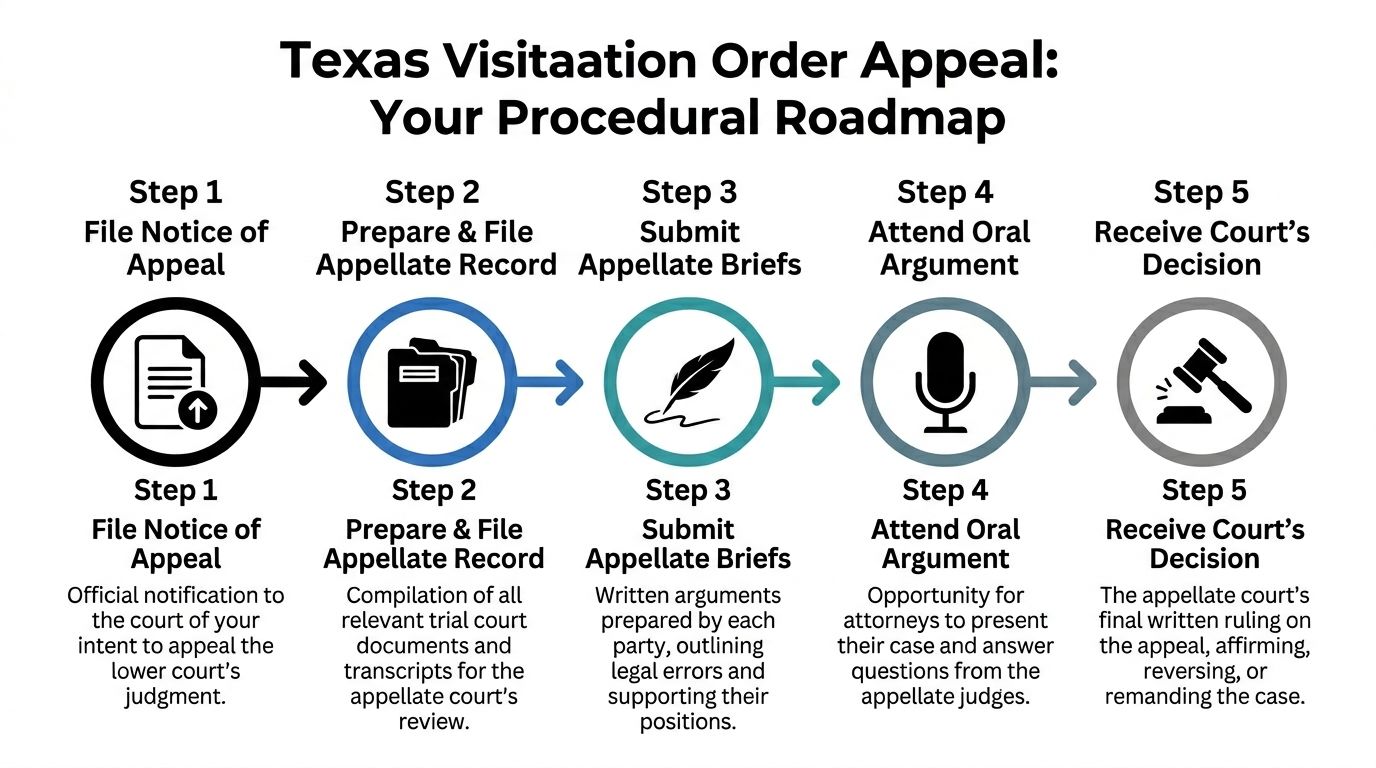
The core sequence
Most visitation appeals follow a predictable sequence, but each step affects the next one:
File the Notice of Appeal
This starts the appellate process and protects your right to review.Request and assemble the appellate record
That includes the clerk's record and the reporter's record. If something important is missing, your appeal gets weaker fast.Draft and file the briefs
The briefs identify the legal errors, cite the record, and explain the remedy you want.Prepare for oral argument if the court sets it
Some cases are submitted on the briefs. Others get oral argument, where the justices test the theory of your case.Wait for the written opinion
The court may affirm the order, reverse it, send the case back, or change part of the judgment.
That sequence sounds simple on paper. It rarely feels simple in practice. Filing the notice is only the start. Work involves choosing issues that can win and making sure the record supports them.
What the record contains
The appellate record is the case file the court of appeals gets to review.
The clerk's record usually includes pleadings, motions, the signed order, written exhibits filed with the clerk, and other papers from the trial court. The reporter's record is the transcript of hearings and testimony. If the hearing was not recorded, or if your lawyer does not request the right portions, the court of appeals may never see the problem you want to raise.
That is why record decisions are strategic, not clerical. A lawyer who understands preserving error for appeal in Texas family court usually starts thinking about the record before briefing begins, not after.
What a brief does
A brief is not a chance to relive the marriage or replay every disagreement about parenting. It is a disciplined legal argument.
A strong brief does four things:
- States the issue in a way the court can decide
- Uses the controlling rule and the right standard of review
- Cites the exact parts of the record that prove the point
- Explains why the error probably affected the outcome
Judges expect focused, rule-based briefing. They do not reward volume. They reward precision.
A weak brief says the result felt unfair. A strong brief shows where the trial court crossed a legal line.
Some appeals move on shorter timelines
Certain family cases tied to child protection proceed on accelerated schedules. In those matters, deadlines for the record, briefing, and disposition are compressed, and courts expect strict compliance, as explained by the Thirteenth Court of Appeals guidance for parental termination and child protection appeals.
Even in a standard visitation appeal, you should act like every deadline matters because it does. Delay creates avoidable risk. It also creates tactical problems if the other parent files a modification request while your appeal is underway.
A practical checklist
| Stage | What your lawyer should be doing |
|---|---|
| Immediately after judgment | Confirm appealability, calculate deadlines, and evaluate whether any post-judgment filings help or hurt |
| Early record phase | Request the needed transcripts, review exhibits, and make sure the signed order matches the ruling |
| Briefing phase | Select preserved issues with a real chance of reversal and tie each one to the record |
| Oral argument prep | Prepare concise answers to the panel's hardest questions |
| Decision phase | Assess remand strategy, enforcement risk, and whether trial court modification proceedings affect next steps |
Practical advice: Bring in appellate counsel before the record is finalized if you can. Early review helps with issue selection, record requests, and the separate question many parents miss: whether a pending appeal should be coordinated with a modification strategy in the trial court.
A dedicated appellate practice focuses on those details. The Law Office of Bryan Fagan, PLLC handles family law appeals by reviewing the trial record, identifying reversible issues, and preparing briefs under the Texas Rules of Appellate Procedure and the Texas Family Code.
Preserving Error and Building Your Appellate Record
Many clients assume an appeal is where they finally get to tell the whole story. That assumption causes damage.
An appeal is limited to the trial court record. The appellate court does not hear new testimony, accept fresh exhibits, or weigh evidence that never made it into the case. If something mattered, it needed to be said, offered, or objected to at trial.
You usually cannot complain later if nobody complained then
Lawyers call this preserving error. In plain English, it means the trial court must have been given a fair chance to fix the problem when it happened.
If opposing counsel offered improper evidence and no one objected, that issue may be waived. If the judge excluded key testimony and trial counsel did not make an offer of proof, the appellate court may not know what was kept out. If a complaint about the wording of the order was never raised, review becomes harder.
That is why appellate lawyers scrutinize the record line by line. They are not just asking whether the ruling felt unfair. They are asking whether the legal complaint exists in a form the court of appeals can decide.
For a deeper look, this guide on preserving error for appeal in Texas family court is worth reading.
What “making a record” means
Making a record means creating a traceable, reviewable history of what happened in court. That often includes:
- Timely objections: Counsel must object when the problem occurs.
- Stated grounds: The objection must tell the court why it is legally improper.
- Rulings by the judge: There must be an actual ruling, or a refusal to rule.
- Offers of proof when needed: If evidence is excluded, the record should show what that evidence would have been.
These details decide whether a complaint is preserved or lost.
Why transcripts matter more than memory
A client may vividly remember the judge cutting off testimony or refusing to consider a document. Memory is not enough. Appellate judges work from pages, not impressions.
That means your appeal rises or falls on things like:
| Record component | Why it matters |
|---|---|
| Hearing transcript | Shows objections, rulings, and witness testimony |
| Exhibits | Shows what evidence the trial court admitted or excluded |
| Signed order | Shows the exact terms being challenged |
| Post-judgment motions | May preserve issues and affect deadlines |
Important: If there is no court reporter’s record for the key hearing, your appellate options may narrow sharply.
This is also why trial representation affects appellate strength. A careful trial lawyer preserves issues. A careless trial lawyer may still create appealable problems, but often for different reasons than the client expects.
The hard truth is simple. You do not get to rebuild the case on appeal. You work with the record you have.
Common Reversible Errors in Texas Visitation Cases
Not every bad visitation ruling is reversible. But some mistakes show up repeatedly in family court appeals, and parents often recognize them once they know what to look for.
Errors tied to the legal standard
Texas courts decide visitation questions under the child’s best interest. A judge can go wrong by applying the wrong legal framework or by treating a personal preference as if it were a rule.
A common example is a court imposing a major restriction without anchoring it to the record or the governing law. Another is entering a possession order that does not line up with what the court found from the bench.
If the legal reasoning is off, the result can be vulnerable even when the hearing was emotionally charged.
Orders the record does not support
Some visitation orders sound decisive but rest on thin support. That is a problem.
Consider a ruling that sharply restricts a parent’s time based on allegations that were never backed up by admissible evidence. Or a supervision requirement that appears in the final order even though the hearing record does not support that level of restriction. Those are the kinds of issues appellate counsel evaluates closely.
In one 2021 appellate decision discussed in the verified materials, the court upheld supervised visitation against challenges that the order was void for not naming a supervisor, while also noting the Family Code allows clarification after the order. The lesson is not that supervision is always safe from review. The lesson is that the exact wording of the order and the statutory framework matter.
Procedural mistakes that can change the outcome
Sometimes the strongest appellate issue is not the final ruling itself. It is the process that produced it.
Examples include:
- A party was denied the chance to present evidence
- Cross-examination was improperly cut off
- The court relied on a theory nobody had notice of
- The signed order contains terms that were never tried
These errors can matter because due process matters. Family courts still have to follow rules, even in urgent or high-conflict cases.
Ambiguous or unworkable visitation terms
A visitation order should be clear enough to follow. If the order is vague, internally inconsistent, or impossible to administer, that creates trouble for everyone.
You may see terms that leave core decisions undefined, build in impossible logistics, or conflict with statutory structure. Sometimes the problem is not who won or lost at trial. The problem is that the written order cannot be applied fairly in daily life.
A quick issue-spotting list
Ask yourself these questions:
- Did the judge rely on evidence that should not have come in
- Did the court block your side from offering key testimony
- Does the signed order say something different from what transpired in court
- Are the visitation terms too vague to follow consistently
- Did the court impose serious restrictions without a clear basis in the record
A parent does not need to diagnose the precise appellate issue alone. But recognizing these patterns helps. Good appeals are built on identifiable legal mistakes, not generalized frustration.
The Strategic Interplay Between Appeals and Modifications
This is the part most online guides miss. Filing an appeal does not always freeze the trial court in place.
In Texas, under Family Code Section 156.101(a), a trial court can consider a motion to modify custody or visitation while an appeal is pending if the moving party shows material and substantially changed circumstances since the original order was signed. That dual-track reality is discussed in this article about trial court jurisdiction during child custody appeals.

That fact changes strategy immediately.
The dual-track problem
A parent may be appealing a visitation order as legally flawed while also facing new developments on the ground. Relocation. Safety concerns. Repeated denials. Changes in the child’s needs. Any of those may lead one side to seek modification before the appeal is resolved.
That creates tension.
If you file a modification yourself, you may strengthen your practical position in the trial court, but you may also complicate the appellate narrative by signaling that circumstances have already moved beyond the original judgment. If you do nothing, the other side may shape the next round of orders while your appeal slowly proceeds on the older record.
When a modification may make sense
A modification can be the right move when new facts arise after the order was signed. The key word is new.
Examples often include:
- A significant change affecting the child’s safety
- A relocation that disrupts the existing possession schedule
- A material shift in a parent’s living or work situation
- A breakdown in how the order operates in practice
These are not appellate issues if they happened later. They belong in a modification case because appeals review the past record, while modifications address changed current conditions.
When to be careful
Do not file a modification because the appeal feels slow. That can muddy the legal strategy.
You need alignment between the appellate goal and the trial-court goal. In some cases, the right approach is to continue the appeal while resisting or shaping modification efforts below. In others, current circumstances become more important than correcting the original ruling.
That judgment requires a sober review of both tracks.
Strategic point: An appeal asks, “Was the signed order legally wrong when entered?” A modification asks, “What order should govern now that circumstances have changed?”
Questions to ask before choosing a path
| Question | Why it matters |
|---|---|
| Did the important facts arise before or after the signed order | Appeals and modifications deal with different timeframes |
| Is the current order causing ongoing harm now | Immediate practical relief may require trial-court action |
| Will a new filing affect appellate positioning | Parallel litigation can create inconsistent arguments |
| Should you seek suspension or other relief | Some situations require targeted procedural requests |
A complex family appeal is rarely just an appeal. It is a moving case with overlapping risks. Parents who understand that early make better decisions.
Take the First Step Toward a Fairer Outcome
A Texas visitation appeal is a disciplined legal review, not a second trial. You need an appealable order, a preserved legal issue, a usable record, and a strategy that matches the situation in both the appellate court and, sometimes, back in the trial court.
That is why speed and judgment matter so much. A rushed filing without a clear theory is weak. Waiting too long is worse. The strongest approach is to evaluate the signed order, the transcript, the deadlines, and any parallel modification risk before choosing the next move.
If the court limited your time with your child unfairly, clarity helps. So does honesty. Some cases are strong appeals. Some are better handled through another procedural tool. Some require both appellate thinking and trial-court strategy at the same time.
You do not need to sort that out alone. A focused appellate review can tell you whether the problem is jurisdiction, preservation, briefing, standard of review, or a deeper structural issue in the order itself.
If you believe the court made a mistake in your family law case, our appellate attorneys can help you seek a fair outcome. Contact The Law Office of Bryan Fagan, PLLC today for a free consultation.