Skip to content
You may feel like the judge heard your case, but did not really hear you.
That feeling is common in Texas family law. A parent leaves court believing key facts were brushed aside, a child’s daily needs were oversimplified, or a ruling was made too quickly to be fair. When the order affects custody, visitation, or parental rights, the result does not just feel legal. It feels personal.
An appeal gives you a structured way to challenge that outcome. In an appellate review of best interest finding texas case, the question is not whether the appellate court would have handled the facts differently at a new trial. The question is whether the trial court followed Texas law, relied on sufficient evidence, and respected due process.
That difference matters. It turns frustration into strategy.
Your Fight for Fairness After an Unjust Ruling
A parent may walk out of a final hearing thinking, “The court focused on one bad moment and ignored everything else.” Another may believe the judge gave too much weight to accusations and too little weight to proof. In a best interest case, those concerns often center on the same painful question. Did the court reach a fair decision for the child, or did it make a legal mistake?
Texas appeals exist for that reason. An appeal is a formal review of what happened in the trial court. It asks whether the judge applied the law correctly and whether the record supports the ruling.
That matters because family court judges have broad authority, but not unlimited authority. They must still follow the Texas Family Code, the Texas Rules of Appellate Procedure, and the constitutional protections that shape parent-child cases.
Consider a common situation. A parent presents evidence of stable housing, school involvement, and a history of meeting the child’s needs. The other side emphasizes conflict, old allegations, or a narrow slice of the record. The judge rules against the first parent. That parent may feel the system rewarded noise instead of facts.
An appeal does not erase that pain. But it does replace guesswork with method.
What fairness looks like on appeal
Fairness in an appeal usually comes down to a few core questions:
- Did the judge apply the correct legal standard
- Was there enough evidence to support the ruling
- Did the court ignore a required presumption or burden of proof
- Did a procedural mistake affect the outcome
A strong appeal is not built on anger. It is built on the record, the rules, and a clear explanation of why the mistake mattered.
If you feel wronged, that feeling should not be dismissed. It should be examined carefully. Sometimes the trial court acted within its discretion. Sometimes it did not. The appellate process exists to tell the difference.
How a Texas Family Law Appeal Differs from a Trial
You leave the courthouse feeling certain the judge missed the bigger picture. By the time you speak with an appellate lawyer, you may hope a new court will hear the full story, meet the witnesses, and correct what happened. Texas appeals do not work that way. The court of appeals studies what the trial court already had in front of it and decides whether the ruling can stand under the law.

That difference matters because appellate success usually comes from identifying a specific legal mistake in the existing record, not from presenting better facts later. If the trial judge used the wrong legal standard, excluded evidence that should have come in, ignored required findings, or entered an order the statute does not permit, an appeal can expose that error. If the missing proof was never offered at trial, an appeal usually cannot supply it after the fact.
The record controls the appeal
An appeal works like a review of the official file and transcript, not a replay of live testimony.
The record usually includes:
- The clerk’s record, such as pleadings, motions, orders, and filed exhibits
- The reporter’s record, which is the written transcript of testimony and objections
- Findings of fact and conclusions of law, if they were requested and filed
Appellate judges read that record closely. They look for what was admitted, what was objected to, what the judge said, and what the final order does. That is why trial objections, offers of proof, requested findings, and precise wording in the order can shape the appeal just as much as the testimony itself.
Clients often ask about new texts, school records, or witnesses discovered after trial. Those facts may support a modification case later. They usually do not become part of a direct appeal. The appeal asks whether the original ruling was legally sound based on the material the trial court had at the time.
Timing starts fast
Appeals are rule-driven from the first day. Once the final order is signed, deadlines begin to run whether you feel ready or not.
A notice of appeal must be filed under the Texas Rules of Appellate Procedure. Other post-judgment filings can affect the timetable, which is one reason early appellate review matters. Waiting too long can forfeit arguments before the court ever considers whether the ruling was fair or legally correct.
Here is the sequence many families see:
| Step | What happens |
|---|---|
| Final order signed | The appellate clock starts running |
| Notice of appeal filed | The appellate court gains authority to review |
| Record prepared | The clerk’s and reporter’s records are assembled |
| Briefing begins | Each side files written legal arguments |
| Court reviews case | Justices study the record and briefs |
| Opinion issued | The ruling is affirmed, reversed, or partly changed |
The brief does the heavy lifting
Trials are built around live testimony, exhibits, and split-second objections. Appeals are built around written analysis.
Your appellate brief must identify the exact ruling being challenged, cite the parts of the record that preserve the complaint, explain the governing law, and show why the error probably affected the outcome. A good brief does more than say the judge was wrong. It shows, step by step, why the ruling falls outside the range Texas law permits. If you want a closer look at how appellate courts evaluate discretionary rulings, this explanation of the abuse of discretion standard in Texas appeals helps frame what the justices are reviewing.
Strategy also becomes real here. In best interest cases, the strongest appellate arguments are often tied to concrete trial court mistakes. A court may have relied on weak or legally irrelevant evidence, failed to apply the proper presumption, or signed an order broader than the pleadings and proof support. In some termination cases, appellate counsel can also use the special review duties recognized in In re N.G. to require careful examination of certain predicate findings because of their lasting consequences. That is not a guarantee of reversal. It is a real strategic opening that can change how an appeal is presented.
Appeals focus on reversible error
The question on appeal is whether the trial court made a mistake that the law recognizes and that likely affected the judgment.
Common examples include:
- Applying the wrong burden of proof
- Ignoring a controlling legal presumption
- Admitting or excluding evidence improperly
- Making a ruling unsupported by the evidence in the record
- Entering an order that conflicts with the governing statute
That focus can feel narrow when you are carrying the emotional weight of the case. It is also what makes the process fair. Appellate courts are there to enforce rules, require reasoned decision-making, and correct rulings that depart from Texas law. In family law appeals, that disciplined review is often the best path to meaningful relief.
Understanding the 'Abuse of Discretion' Standard of Review
When Texas appellate courts review a best interest ruling, they usually apply the abuse of discretion standard. That phrase sounds harsh, but it has a specific legal meaning.
It does not mean the appellate court asks whether the trial judge made the best decision. It asks whether the judge made a decision that Texas law allows on the evidence presented.
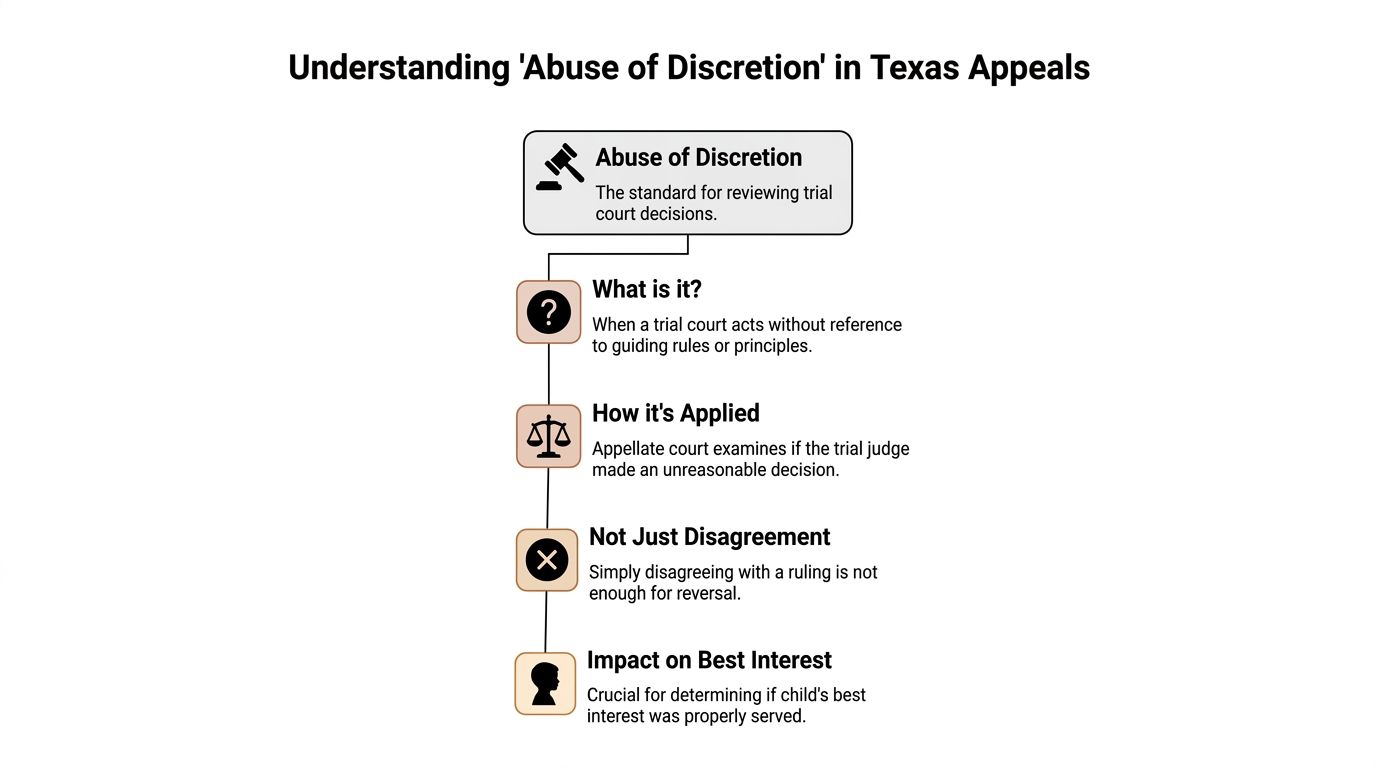
In Texas family law appeals involving best interest findings under Texas Family Code § 153.002, appellate courts apply an abuse of discretion standard and reverse only when the ruling is arbitrary, unreasonable, or made without reference to guiding legal principles. The same source also notes that appellants must show harmful error under Texas Rule of Appellate Procedure 44.1, and that custody appeal success rates are below 20% due to this deference, according to Texas Law Help’s discussion of the best interest standard.
What abuse of discretion means in plain English
A trial judge has room to choose between reasonable options. Family cases are fact-heavy, and trial judges directly observe witnesses. Appellate courts respect that role.
But trial judges are not free to rule however they want.
A judge abuses discretion when the ruling is:
- Arbitrary, meaning it lacks a rational basis in the record
- Unreasonable, meaning it falls outside the range of acceptable judicial choices
- Without reference to guiding legal principles, meaning the court ignored or misapplied the law
A helpful way to think about it is this. Two judges may look at the same custody dispute and choose different possession schedules. If both choices are legally supported, an appellate court may affirm either one. But if a judge shifts the burden to the wrong party, ignores a required presumption, or enters a ruling unsupported by the record, the problem becomes appellate.
Sufficiency review lives inside this standard
Best interest appeals often confuse people because “abuse of discretion” and “sufficiency of the evidence” seem like different concepts. In practice, they work together.
The appellate court asks whether the trial judge had enough evidence to exercise discretion lawfully. That usually includes two related questions.
Legal sufficiency
A legal sufficiency challenge is often called a “no evidence” point.
The question is whether the record contains evidence that could support the trial court’s finding. If there is no evidence on a required point, the ruling may fail even under a deferential standard.
Example: If a court restricts a parent’s rights based on danger to the child, but the record contains no evidence supporting that concern, legal sufficiency becomes central.
Factual sufficiency
A factual sufficiency challenge is different. It accepts that some evidence exists, but argues the supporting evidence is too weak, or the contrary evidence is too strong, for the ruling to stand.
This is a harder argument because appellate courts do not reweigh every fact from scratch. They defer to the trial court’s ability to judge credibility.
Still, factual sufficiency matters in close cases. If the record shows a major imbalance between the finding and the proof, an appellate court can intervene.
For a deeper discussion of this standard in family appeals, this explanation of the abuse of discretion standard in Texas appeals is useful.
A short video overview can also help make the concept easier to follow.
Harmful error is the missing piece many people overlook
Not every mistake leads to reversal.
Texas Rule of Appellate Procedure 44.1 requires harmful error. That means the error must probably have caused an improper judgment or prevented a proper presentation of the case on appeal.
Here, many understandable client complaints fall short. A judge may have spoken sharply, limited repetitive testimony, or ruled against a motion in a way that felt unfair. But if the mistake did not affect the outcome, reversal is unlikely.
What clients often get wrong
Here is a quick comparison:
| Client reaction | Appellate question |
|---|---|
| “The judge believed the wrong person” | Was there legally sufficient evidence to support the finding |
| “The ruling felt unfair” | Was it arbitrary, unreasonable, or contrary to law |
| “The judge ignored important facts” | Does the record show a harmful error or insufficient evidence |
| “I want to introduce new proof” | Is that proof already in the appellate record |
Disagreement is not enough. The issue is whether the ruling crossed the line from judicial choice into legal error.
That is the heart of appellate review in best interest cases. The standard is demanding, but not hopeless. A well-built appeal identifies the exact place where discretion ended and error began.
The Holley Factors and Evidentiary Sufficiency Review
When Texas courts decide what is in a child’s best interest, they often look to the Holley factors. These factors come from Holley v. Adams and guide courts through a non-exclusive set of considerations.
They are not a checklist that must be proved one by one. But they give appellate lawyers a practical map for reviewing the evidence.

A recent example appears in the Eleventh Court of Appeals’ February 27, 2026 decision in In re K.H., K.A., and K.A., where the court affirmed termination after holding that evidence of the mother’s drug use history, concealment of a child’s location, and exposure of children to controlled substances was sufficient to support the best interest finding under Texas Family Code § 161.001(b)(2), as summarized in this discussion of the 2026 Texas parental-rights termination decision.
The Holley factors in plain language
The factors commonly include:
- The child’s desires
- The child’s emotional and physical needs now and in the future
- Any emotional or physical danger to the child now and in the future
- The parental abilities of the people seeking custody
- Programs available to help those people
- Plans for the child
- The stability of the proposed home
- Acts or omissions showing the parent-child relationship may be improper
- Any excuse for those acts or omissions
A trial court does not have to discuss every factor out loud. But the record should support the best interest ruling in a meaningful way.
How appellate lawyers use the factors
On appeal, the question is not whether one parent can point to some favorable facts. Most family cases contain mixed evidence.
The core question is whether the evidence supporting the ruling was legally and factually sufficient when viewed through the Holley framework.
Here is how that often works in practice:
Looking for missing proof
A legal sufficiency argument may focus on a factor the trial court relied on without firm record support.
For example, if a court strongly emphasizes instability, but the record shows stable housing, consistent school involvement, and no contrary evidence of danger, the appeal may argue there was no evidence supporting the court’s concern in the way the order suggests.
Weighing weak proof against stronger proof
A factual sufficiency argument accepts that some unfavorable evidence exists, but argues it was too thin to justify the final ruling when compared with the full record.
This often happens where a parent had past problems but presented strong evidence of current stability, treatment, or compliance, and the court still issued a sweeping restriction without enough support.
For readers dealing with record-based evidence challenges, this overview of a factual sufficiency appeal in Texas family law may help.
A useful way to organize the record
Appellate lawyers often review the transcript and exhibits factor by factor, not witness by witness.
That method helps reveal patterns such as:
| Holley area | Record question |
|---|---|
| Child’s needs | What proof showed daily care, schooling, health, and routine |
| Danger | Was there real evidence of risk, or just speculation |
| Stability | Did the record show a stable home, employment, and follow-through |
| Parental ability | What specific acts showed good or poor judgment |
| Plans for the child | Were the plans realistic, lawful, and supported |
This approach matters because “best interest” is a broad phrase. Broad phrases can hide weak reasoning. Appellate review forces the court to tie the result back to evidence.
“Best interest” is not a shortcut. It must be supported by facts in the record.
Why this part of the appeal is so technical
Clients often ask why a plainly unfair ruling is still difficult to reverse. The answer is that appellate courts defer heavily to trial judges on fact questions, especially when witness credibility mattered.
That is why the strongest best interest appeals are usually specific. They do not just argue that the judge got it wrong. They point to a precise gap between the ruling and the evidence.
Sometimes that gap is a total absence of evidence. Sometimes it is a record so lopsided that the finding becomes unjust. Either way, the Holley factors give structure to that argument.
Common Reversible Errors in Texas Best Interest Cases
You leave the courtroom knowing the ruling was unfair. The problem is that an appeal cannot be built on that feeling alone. It has to identify a specific legal mistake, show where it appears in the record, and explain why it mattered to the result.
That is what reversible error means in a Texas best interest appeal.

Some errors are easy to name but hard to prove. Others hide in plain sight. A judge may recite the right legal rule, then decide the case in a way that shows the wrong burden was used, a required presumption was ignored, or a major finding rested on guesswork instead of evidence. Appellate strategy starts by finding that disconnect.
Ignoring the fit-parent presumption
One recurring error appears when a trial court treats a fit parent’s decisions as if they carry no special weight.
Texas law starts from a basic constitutional premise. A fit parent is presumed to act in the child’s best interest. That presumption matters because it sets the starting point for the case. If the court acts as though the parent must prove ordinary parental choices were correct, the burden may have been flipped from the outset.
That kind of error can shape everything that follows, including possession terms, decision-making rights, and limits on parental authority.
Treating suspicion as evidence
Another common problem is a ruling built on labels instead of proof.
Words like “instability,” “danger,” and “poor judgment” can sound persuasive at trial. On appeal, those words have to be tied to concrete facts in the record. A best interest finding cannot rest on loose impressions, isolated complaints, or fear about what might happen later.
This issue shows up often in cases involving:
- custody rulings supported by vague concerns rather than specific proof
- modification orders entered without enough evidence of the statutory basis for change
- visitation restrictions based more on speculation than documented risk
A trial judge has room to weigh facts. A judge does not have room to fill gaps in the evidence with assumptions.
Applying the wrong legal framework
Best interest is not the only rule in play. It works alongside other requirements in the Family Code.
In a modification case, for example, the court must address the legal basis for changing the existing order before it can choose the arrangement it prefers. In a relocation dispute, the court cannot treat the issue as a free-form fairness call while skipping over the governing standards. The same problem can arise in school choice, geographic restriction, and possession disputes. Here, appellate review becomes practical, not abstract. If the trial court solved the wrong legal problem, the appeal can focus on that error directly rather than arguing in general terms that the result felt unjust.
Using the wrong burden of proof
Burden of proof issues often decide family cases indirectly.
A court may say the correct standard out loud, then proceed as if one parent had to disprove every accusation or justify every parenting decision. That is like starting a race after moving one runner ten yards behind the line. The written order may look ordinary. The reporter’s record may show something very different.
When appellate counsel can trace that burden shift through the testimony, objections, rulings, or findings, the issue becomes much stronger.
Failing to review termination grounds with due process in mind
Termination cases present a separate strategic opening. Some statutory grounds carry consequences beyond the immediate case, including future proceedings involving the same parent.
That is why the Texas Supreme Court’s decision in In re N.G. matters so much. It requires appellate courts to examine challenged grounds that can have collateral consequences, even if another ground might also support termination. That review requirement gives parents a real chance to correct harmful findings that would otherwise remain on the books untested.
For families, this point is easy to miss. For appellate strategy, it can be decisive.
Where appellate opportunities often emerge
Many successful appeals do not come from one dramatic mistake. They come from a pattern:
- the court ignored a controlling presumption
- the evidence addressed only part of the finding
- the judge applied a best interest analysis before resolving the required threshold issue
- the order rested on broad conclusions that the record does not support
- a termination ground was affirmed without the level of review due process requires
That pattern matters because appellate courts are not deciding who seemed more believable in the moment. They are deciding whether the law was applied correctly and whether the record can support the judgment that was signed.
A strong appeal turns a general sense of unfairness into a precise explanation of what the trial court got wrong, where the record shows it, and why the error changed the outcome.
Preserving Your Rights and Crafting a Winning Appeal
Some of the most important appellate work happens before the appeal begins.
A parent may have a valid complaint, but if the issue was not properly preserved in the trial court, the appellate court may never reach it. That is why preservation of error is so important.
What preservation of error means
In plain English, preservation usually means this: the trial court must have been given a fair chance to correct the mistake.
That often requires:
- A timely objection
- A clear legal basis for the objection
- A ruling by the trial court, or a refusal to rule
- A record showing what happened
If no objection was made to evidence, procedure, or an improper argument, the issue may be waived on appeal.
That does not mean every appellate issue depends on an objection. Some legal errors can still be raised based on the face of the order or the sufficiency of the evidence. But many strong appellate points are lost because the record was not preserved carefully.
Findings, deadlines, and the appellate record
In best interest cases, findings of fact and conclusions of law can be especially useful. They help identify the factual and legal basis for the ruling.
When findings are missing, vague, or incomplete, the appeal may become harder. When they are detailed, they can reveal exactly where the trial court went wrong.
A strategic appellate review often begins with these questions:
| Record issue | Why it matters |
|---|---|
| Was the final order final | Appeals usually require a final, appealable order |
| Were objections preserved | Many evidentiary issues depend on this |
| Were findings requested | Findings can narrow and sharpen appellate issues |
| Is the reporter’s record complete | Missing transcripts can cripple review |
What a brief does
A brief is the centerpiece of most appeals.
It is not a letter to the court. It is not a summary of everything that felt unfair. It is a formal legal document that identifies the issues presented, states the facts with record citations, explains the governing law, applies the law to the record, and requests a specific remedy.
A strong brief usually does three things well:
It narrows the case
It picks the best issues, not every possible complaint.It cites the record precisely
Appellate judges want to see exactly where the error appears.It explains harm clearly
It shows why the mistake mattered to the outcome.
Good appellate writing is disciplined. It tells the court where to look, what rule applies, and why the error requires relief.
A strategy opportunity many lawyers still miss
Termination cases now present an added opening. As discussed in commentary on Interest of N.G., the Texas Supreme Court requires appellate courts to conduct a thorough review of all grounds cited for termination, not just one sufficient ground, creating an underused strategy point for lawyers challenging incomplete lower-court reasoning in the Texas Supreme Court’s full-review mandate in termination cases.
That matters because an appellate lawyer can argue not only that a best interest finding was flawed, but also that the court failed to fully analyze alternative grounds with the depth due process requires.
Why early appellate review helps
Even after a trial ends, time remains short. An early appellate consultation can help identify:
- preserved issues,
- missing record items,
- post-judgment deadlines,
- and whether the case is stronger as a direct appeal, another post-judgment motion, or a later modification.
That kind of review brings order to a moment that often feels chaotic. It also prevents a parent from spending time and money on arguments that sound powerful but are not legally viable.
Your Path to Appellate Justice Starts Here
The judge signs the order. You leave the courthouse feeling like the court heard the other side's story, but not yours. In that moment, an appeal can feel like the only remaining way to ask for a fair review by a new court that focuses on rules, proof, and whether the result can legally stand.
That matters because appellate courts do more than ask whether a ruling seems harsh. They examine whether the trial court applied the right legal standard, relied on evidence that can support a best interest finding, and made errors serious enough to require a new result or a new hearing. In parental-rights and conservatorship cases, that review is one of the clearest due-process protections the system provides.
The result usually falls into one of three categories:
- Affirm. The court of appeals leaves the order in place.
- Reverse and remand. The court sends the case back because the error requires the trial court to do the work again under the correct rules.
- Reverse and render. The appellate court enters the judgment the trial court should have entered, usually when the law and record permit only one proper outcome.
Which result fits depends on the type of mistake and what the record shows. A harmful evidentiary ruling, a failure to apply the Holley factors with adequate support, or an incomplete termination analysis can create real appellate openings. As noted earlier, termination appeals also present a strategic opportunity when the reviewing court must address each challenged ground with the level of review due process requires.
If you believe the ruling was wrong, act quickly. Deadlines arrive fast, and the first job is to turn a painful experience into a precise legal argument.
Start with the final order, the hearing and trial dates, the reporter's record if one exists, and any findings of fact and conclusions of law. Then ask the question appellate courts answer: what specific legal error in this record probably led to this result? That question helps separate arguments that feel strong from arguments that can win.
A lawyer who focuses on appeals can spot issues that are easy to miss in the first days after judgment. If you want to see how that review works in practice, this page on working with a Texas family law appeal attorney explains the process in plain English.
Families often start learning about appellate rights online before they ever call a lawyer. If you are interested in how firms explain difficult legal topics clearly, this guide to digital marketing for law firms offers helpful context.
A good appeal does not promise miracles. It identifies the mistake, ties that mistake to the governing standard of review, and shows why the error affected the outcome. That is how appellate courts correct unfair results, protect parental rights, and require trial courts to follow the law.