You may feel your case was handled unfairly, and if your divorce involved a family business, a flawed valuation is often the reason. In Texas, a divorce decree must result in a "just and right" division of your community property. When a court miscalculates a business's value, you can be left with a fraction of what you are rightfully owed, jeopardizing your financial future. This isn't just a disagreement; it's a potential legal error that can be corrected on appeal.
What You Can Appeal in a Texas Divorce Involving a Business
When you and your spouse built a business, its value represents more than just numbers on a spreadsheet; it’s a product of shared sacrifice and hard work. If that value is miscalculated during your divorce, the entire property division becomes fundamentally unjust.
A botched business valuation is more than a simple mistake—it can be what appellate courts call a reversible error. A reversible error is a legal mistake made by the trial judge that is significant enough to have likely caused an improper outcome. If the judge based your property division on a fundamentally incorrect valuation, that decision may be considered an "abuse of discretion." This is a powerful legal argument for seeking a fair outcome through an appeal.
Understanding the Stakes of a Flawed Valuation
An inaccurate valuation isn't a minor detail; it's a critical error with potentially devastating consequences. We see this happen in a few common ways:
- Using the wrong valuation method: A judge might value a thriving service-based business based only on its physical assets, completely ignoring its most valuable component: future earning potential or goodwill.
- Choosing an improper valuation date: A business's value can fluctuate significantly. Valuing it on a date that is not "as close as practicable" to the date of trial can artificially deflate its worth.
- Failing to uncover hidden assets: An owner-spouse might intentionally underreport the business's income or hide assets to unfairly minimize their spouse's share of the community estate.
- Ignoring credible expert testimony: The court might dismiss a well-supported valuation from a qualified professional without a valid legal reason.
These are not just financial disagreements; they are potential legal errors that can be challenged on appeal. The complexities of a divorce business valuation often intersect with intricate family law tax issues, making expert guidance essential.
The table below explains some of the key terms you will encounter. Understanding these concepts is the first step in identifying potential errors in your divorce decree.
Key Valuation Concepts in a Texas Divorce
| Concept | Plain-English Explanation | Why It Matters in an Appeal |
|---|---|---|
| Community Property | In Texas, this includes all property and debt acquired by either spouse during the marriage, with few exceptions. | A business started or grown during the marriage is community property. If the court mischaracterizes it as separate property, the entire asset division is legally flawed. |
| Valuation Date | The specific date chosen to determine the business's worth. Texas law requires this date to be at or near the time of trial. | Using the wrong date can drastically alter the value. Arguing the court used an improper date is a common ground for appeal. |
| Fair Market Value (FMV) | What a willing buyer would pay a willing seller, with neither being under pressure to act. This is the legal standard in Texas. | If the court used a different standard (like liquidation value) without a legally sound reason, it may be an abuse of discretion. |
| Goodwill | The intangible value of a business, like its reputation and customer base. It can be personal (tied to one spouse) or enterprise (tied to the business). | Texas law requires courts to distinguish between personal goodwill and enterprise goodwill. Failing to do so is a frequent reversible error. |
Getting these concepts right is critical. If the trial court got them wrong, the entire property division could be built on a faulty legal foundation.
An appeal is not a retrial or a second chance to introduce new evidence. The goal of an appeal is to demonstrate to a higher court that the trial judge made a significant legal error based on the evidence and arguments presented at trial. Proving the court abused its discretion in the business valuation is a strategic path toward seeking a new, more just outcome.
If you believe the division of your marital estate was based on a flawed business valuation, it is important to act quickly. To learn more about how our appellate attorneys analyze these complex financial details, review our comprehensive guide on divorce business valuation.
How Texas Courts Determine a Business's Worth
When a Texas court divides community property, it cannot simply guess at a business's value. The judge must rely on established, legally accepted valuation methods. Understanding these methods is the first step to spotting a reversible error—a legal mistake made at trial—that could be successfully challenged on appeal.
A business valuation divorce is far from simple. At its core, any valuation aims to determine the business's fair market value. This is not what one owner hopes it is worth, but what an objective buyer would reasonably pay for it on the open market. To arrive at that number, experts typically use one of three core approaches.
The Asset-Based Approach
This method involves creating a detailed inventory of everything the business owns and owes. An expert adds up all assets—cash, equipment, real estate, inventory—and then subtracts all liabilities, like debts and accounts payable.
This approach is suitable for businesses whose value is primarily tied to their physical assets, such as a real estate holding company. However, it often fails to capture the true value of a service business, like a successful medical practice or consulting firm, because it can ignore the company's ability to generate future profits. Relying on this method alone for a service business can be a significant legal error.
The Market-Based Approach
This method is similar to pricing a home for sale. The valuation expert researches recent sales of comparable businesses in the same industry and geographic area. By analyzing what similar companies sold for, they can establish a reliable benchmark for the business being valued in the divorce.
The challenge, however, is finding businesses that are truly comparable. This can be difficult for a unique or niche company. If the court accepts a valuation based on a comparison to a business that is significantly different in size, revenue, or market position, the final number will be flawed, creating a potential ground for appeal.
The Income-Based Approach
For most profitable, ongoing businesses, this is the preferred method. It values the company based on its future earning power. Experts analyze historical earnings to project future cash flow, then discount that income stream to a present-day value. This is especially critical for service businesses where the real value lies in goodwill and client relationships, not just physical assets.
Crucial Takeaway: The choice of valuation method is not arbitrary; it must be the right tool for the specific business. A trial court that approves a valuation using an inappropriate method—for example, an asset-based approach for a thriving law firm—may have committed an abuse of discretion. This is a powerful argument for an appeal.
Achieving a fair property division requires a valuation that is both thorough and legally sound. The level of detail needed is similar to the due diligence performed in mergers and acquisitions due diligence process, where every aspect of a business's financial health is scrutinized.
The concept map below illustrates how a proper business valuation is central to achieving a fair property division and securing a stable financial future.
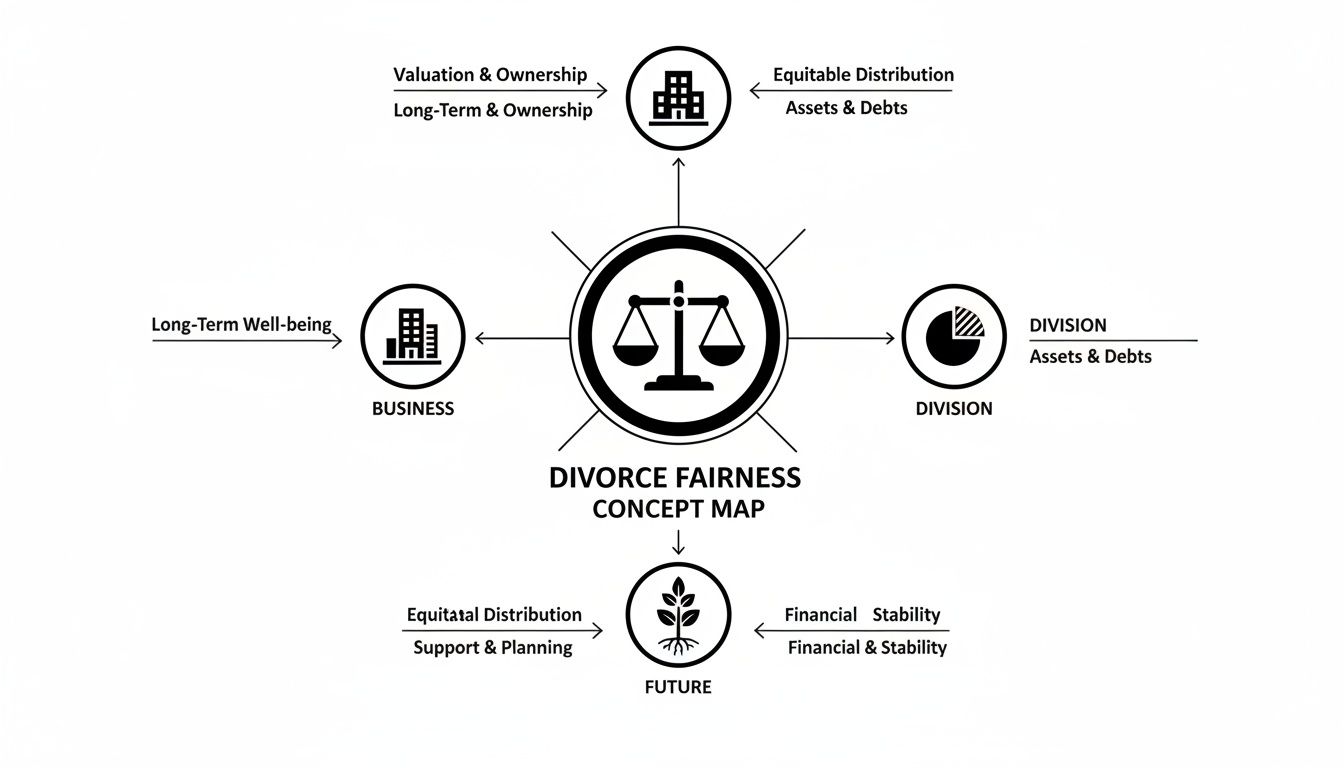
As you can see, these elements are interconnected. An error in the business valuation can throw the entire divorce decree out of balance.
Common Reversible Errors in a Business Valuation Divorce Case
When a divorce decree feels profoundly unjust, a flawed business valuation is often the root cause. It is important to remember that an appeal is not a second trial where you can present new evidence. Rather, it is a focused review of the trial record to identify specific legal mistakes, or "reversible errors," made by the judge.
If the court incorrectly valued your business, it could have skewed the entire property division. Our role as appellate counsel is to meticulously review the trial record, pinpoint those critical mistakes, and build a persuasive legal argument to demonstrate to the higher court why the outcome was unjust.

Abuse of Discretion: Understanding the Standard of Review
One of the most effective arguments on appeal is that the trial judge committed an “abuse of discretion.” This is a legal term that means the judge’s decision was unreasonable, arbitrary, or made without regard for guiding legal rules and principles. It is a key standard of review in family law appeals.
In a business valuation context, an abuse of discretion might occur if a judge:
- Ignores the credible, well-documented testimony of a valuation expert without a valid reason.
- Accepts a valuation method that is legally inappropriate for the type of business involved.
- Makes a decision that has no support in the evidence presented at trial.
Incorrect Application of Valuation Principles
Even when a judge selects the correct general method, errors can still occur in the application of specific financial principles. These mistakes are often grounds for a successful appeal in a business valuation divorce. For example, certain risks tied to a company can impact its fair market value by as much as 25-40%. A business with $500,000 in annual earnings might be valued at $2.5 million, but that number can change dramatically if the court misinterprets or ignores key financial data. You can review this in-depth analysis of critical factors in divorce-related business appraisals to see how these details affect the final number.
Some of the most common reversible errors we identify include:
- Using the Wrong Valuation Date: Texas law requires that a business be valued as close to the date of trial as possible. A company's value can change significantly over time. If the court uses an outdated or arbitrary date, the valuation is unreliable and can lead to an unjust property division.
- Failure to Distinguish Goodwill: This is a critical issue in Texas. The law requires a clear separation between personal goodwill (value tied to a spouse’s unique skills or reputation) and enterprise goodwill (value inherent to the business itself). Only enterprise goodwill is divisible community property. If a valuation improperly includes personal goodwill in the community estate, it is a clear and significant legal error.
- Ignoring Key Financial Data: An appeal may also succeed if the court overlooked crucial evidence presented at trial, such as hidden assets, understated income, or significant business debts that reduce the company’s net value.
A successful appeal is not about showing the judge could have reached a different valuation. It is about proving that the valuation they did reach was legally incorrect based on the law and the evidence. Our role is to construct that argument, using the trial record and Texas law to show the appellate court precisely where the judge erred.
Procedural and Evidentiary Errors
Sometimes, the grounds for an appeal are found not in the final number but in the process used to arrive at it. For example, a judge might improperly exclude your expert from testifying on a key issue or admit unqualified or unreliable testimony from the other side. The Texas Rules of Evidence are designed to ensure fairness. When they are not followed, the entire valuation process can be compromised, making the final decision unsound and subject to appeal.
How Appeals Differ from Trials: The Role of the Appellate Record
When a business is part of a divorce, the testimony from a valuation expert—such as a forensic accountant or certified business appraiser—is often the most critical evidence presented at trial. Their analysis provides the judge with the financial context needed to achieve a "just and right" division of your community property.
But what happens if the judge disregards your expert’s sound analysis or accepts a deeply flawed valuation from the other side? This is where a family law appeal can provide a remedy. Our appellate team will analyze the trial record to determine if the judge’s decision is legally supported by the evidence that was presented in court.

Scrutinizing the Trial Record for Reversible Error
An appeal is fundamentally different from a trial. We cannot introduce new evidence or call new witnesses. Our entire focus is on the trial record, which is the official collection of everything that happened in the original case.
This record consists of two key parts:
- The Reporter’s Record: The word-for-word transcript of all testimony in court, including the detailed questioning of each side's valuation expert.
- The Clerk’s Record: All documents filed in the case, such as valuation reports, financial statements, tax returns, motions, and the judge's final orders.
Our appellate attorneys meticulously review every page of this record, searching for inconsistencies, flawed methodologies, and any disconnect between the evidence and the judge's final decision. The goal is to identify a reversible error—a mistake so significant that it likely led to an improper judgment.
Challenging an "Abuse of Discretion"
One of the most common arguments in an appeal of a flawed business valuation divorce is that the trial judge committed an "abuse of discretion." This means the judge’s decision was arbitrary, unreasonable, or made without proper consideration of the facts and the law.
Examples of an abuse of discretion in a valuation case include:
- Ignoring Credible Testimony: A judge completely disregards a qualified expert’s well-supported conclusions without providing a valid legal reason.
- Adopting a Flawed Valuation: The court relies on an expert report that used an improper valuation method, contained clear mathematical errors, or was based on faulty assumptions.
- Misinterpreting the Evidence: The judge overlooked crucial financial documents or misunderstood expert testimony, leading to a valuation that does not align with the evidence.
While appellate courts give trial judges significant deference, that deference is not absolute. A judge cannot simply pick a number arbitrarily. Their decision must be grounded in the evidence presented in the record. When it is not, that failure provides grounds for an appeal.
The Power of a Strong Trial Record
This is why the quality of the expert testimony and evidence presented at the original trial is so critical. An appeal is won or lost based on the strength of the arguments we can build from the existing record.
Our job as appellate counsel is to write a persuasive legal brief that guides the appellate judges through the evidence, step-by-step, and pinpoints exactly where the trial court went wrong. We demonstrate how a flawed valuation directly led to an unjust property division, violating the Texas Family Code’s mandate for a "just and right" result. By systematically deconstructing the trial court’s reasoning and showing how it conflicts with the facts in the record, we build a powerful case for reversal. Understanding how different assets are valued is a crucial first step; you can learn more in our guide on the role of an appraisal for divorce.
Navigating the Texas Divorce Appeals Process: A Step-by-Step Guide
If you believe the court made a mistake in your business valuation, you have a path to seek justice. The Texas appellate process is designed to correct significant legal errors made at trial, but it operates under a different set of rules and timelines.
An appeal is a review, not a retrial. No new witnesses are called, and no new evidence is introduced. Instead, a panel of appellate judges examines the existing trial record to determine if the trial judge made a "reversible error"—a mistake serious enough to have changed the outcome. Your case now depends entirely on the strength of the written legal arguments presented in your appellate brief.
Step 1: Filing the Notice of Appeal
The appellate process begins with a strict, non-negotiable deadline. Under the Texas Rules of Appellate Procedure, you generally have just 30 days from the date the judge signs the final divorce decree to file a Notice of Appeal.
If you miss this 30-day deadline, your right to appeal is likely lost forever, no matter how flawed the original valuation was. The timeline is unforgiving, which is why you must consult an appellate specialist as soon as you receive an unfavorable result. To learn more about this critical first step, read our guide on what a Notice of Appeal is.
Step 2: Preparing the Official Appellate Record
After the notice is filed, the next step is to assemble the official appellate record. This is the complete collection of everything that happened in the trial court and is the only evidence the appellate judges will review.
The record is composed of two parts:
- The Clerk’s Record: A compilation of all filed documents—pleadings, motions, financial reports, expert opinions, and the final decree.
- The Reporter’s Record: The official, word-for-word transcript of all in-court proceedings, including all testimony from your valuation expert.
Our appellate team meticulously reviews this record to identify the errors that will form the basis of your appeal.
Step 3: Legal Briefing
This is the core of the appellate process. Briefing involves drafting a persuasive legal document that is submitted to the court of appeals. This brief is our opportunity to explain precisely what legal errors occurred at trial and why they matter. A powerful appellate brief is more than a complaint; it is a structured, logical argument that connects the trial court's errors to the unjust outcome, showing the appellate judges how the property division violated Texas law.
The appeal is almost always won or lost based on the strength of the written brief. It requires the unique skill of dissecting complex financial testimony, identifying subtle legal missteps, and weaving them into a compelling narrative that convinces a panel of judges to reverse the trial court’s decision.
Answers to Your Top Questions About Valuation Appeals
If you are facing a divorce decree that seems unfair due to a flawed business valuation, you likely have many questions. The appeals process can seem intimidating, but understanding it is the first step toward seeking a fair outcome.
Here are answers to some of the most common questions we receive.
How Long Do I Have to Appeal a Divorce Decree in Texas?
The timeline is extremely strict. In Texas, you typically have only 30 days from the date the judge signs the final divorce decree to file a Notice of Appeal. This is a firm deadline under the Texas Rules of Appellate Procedure. If you miss it, you almost certainly lose your right to challenge the court's decision, no matter how incorrect it was. It is crucial to contact an appellate lawyer immediately if you are considering an appeal.
What Happens When a Case is "Remanded"?
If the court of appeals finds a reversible error in how the business was valued, it will typically "remand" the case. This does not mean the appellate court sets a new value for the business. Instead, "remand" means the case is sent back to the original trial judge with specific instructions on how to correct the legal mistake. For example, the appellate court might order the judge to apply the correct valuation date or to properly distinguish between personal and enterprise goodwill. A remand gives you a second chance to achieve a truly "just and right" property division based on a correct application of the law.
Can I Introduce New Evidence on Appeal?
No. This is a fundamental difference between a trial and an appeal. The appellate court is limited to reviewing only what was presented at the original trial—the testimony, expert reports, and financial documents that make up the "record." The purpose of an appeal is to argue that the trial judge made a legal mistake based on the information they had at that time. We cannot introduce a new appraisal or call a new expert. Our role is to show the appellate court that the judge erred based on the evidence already in the record.
What Does a Valuation Appeal Cost?
The cost can vary, but it should be weighed against the potential loss from an incorrect valuation. The financial stakes in a business valuation divorce can be enormous. A valuation alone can cost $6,500 to $13,000 for a small business, with costs increasing for more complex companies. For many couples, a business represents 50-90% of their total net worth. An error in its valuation can result in a loss of hundreds of thousands, or even millions, of dollars. You can read more about these high-stakes divorce valuations. An appeal should be viewed as an investment in correcting a potentially devastating financial error and restoring fairness.
If you believe the court made a mistake in your family law case, our appellate attorneys can help you seek a fair outcome. Contact The Law Office of Bryan Fagan today for a free consultation.